Compliance Risk Management Framework Guide for Canadian SMBs
Build a practical compliance risk management framework for your Canadian SMB. Map NIST, ISO 27001, HIPAA, and SOC 2 controls

Build a practical compliance risk management framework for your Canadian SMB. Map NIST, ISO 27001, HIPAA, and SOC 2 controls

In 2023-24, 693 PIPEDA breach reports affected roughly 25 million Canadian accounts, more than double the prior year. That's proof an annual checklist is no longer a defensible compliance posture. A working compliance risk management framework has to run quarterly, assign owners, and produce evidence you can show a regulator, insurer, or client on demand.
For Canadian SMBs, this isn't about buying another dashboard. It's about connecting assets, people, and workflows to controls that someone tests. Weak access governance, stale vendor lists, and untested backups fail audits more often than missing tools do.
Private-sector organisations reported 693 breaches in 2023-24, up from 681 the previous year, affecting approximately 25 million Canadian accounts, according to the OPC annual report for 2023-24. The volume barely changed. The scale more than doubled, which tells you a single failure now reaches far more people.
That pattern isn't new. Organisations voluntarily reported only 44 breaches in 2014 compared with 60 in 2013, then reported 645 PIPEDA breaches affecting at least 1.9 million accounts in 2021-22 after mandatory reporting took effect, as shown in the OPC annual report for 2021-22. In other words, low numbers once reflected low reporting, not low risk.

A defensible program rests on five pillars: risk identification, control ownership, third-party oversight, incident response, and corrective-action tracking with executive reporting. Teams that need a starting workflow can adapt practical GRC implementation steps from CEFCore, then map them to PIPEDA, provincial health and privacy laws, and sector rules.
If you can't name the control owner, evidence location, and last test date, you don't have a control yet. You have an intention.
That's why boards should treat framework ownership as governance, not an IT ticket.
Canadian SMBs waste money when they chase a label before they define scope. Pick the framework your clients, insurers, and regulators ask for, then map shared controls once. Our guide to NIST Cybersecurity Framework 2.0 for SMBs is a useful starting point if you're beginning with NIST.
| Framework | Best fit | Certification | Audit burden | Canadian alignment |
|---|---|---|---|---|
| NIST CSF | Broad SMB baseline | None, self-assessed | Lower, internal review | Maps well to Cyber Centre Baseline Controls |
| ISO 27001 | Firms selling internationally | Formal certification | Higher, external auditor | Strong general governance fit |
| SOC 2 | SaaS and professional services | Attestation report | Moderate to high | Useful for client assurance |
| HIPAA | US health information work | No official certification | Moderate, rule-based | Doesn't replace PHIPA or PIPEDA |
NIST CSF suits organisations that need structure without a certification project. ISO 27001 makes sense when international customers require certified information security management and you'll sustain the audit cycle. SOC 2 fits service organisations that must demonstrate controls over client data over time. HIPAA is mandatory only where US protected health information is in scope. It doesn't satisfy Canadian duties on its own.
Whatever you choose, include end-of-life handling. Asset disposal breaks otherwise solid programs, and these data sanitization compliance tips from Reworx Recycling outline why destruction evidence belongs in your control set. Don't pick two frameworks at once unless you've mapped overlaps. Duplicated evidence is where small teams burn out.
Start with the Canadian Centre for Cyber Security Baseline Cyber Security Controls, which target organisations with fewer than 500 employees and require documenting in-scope systems, exclusion rationale, and risk acceptance, as set out in Cyber Centre guidance for small and medium organisations. That gives you a Canadian spine instead of a generic import.

Executives should receive the inventory, register, treatment plan, and monitoring schedule. If stage one is sloppy, stages two to five are fiction. Focus extra effort there.
A policy PDF nobody opens won't survive scrutiny. Convert your compliance risk management framework into a quarterly control matrix, one row per control, with owner, implementation status, evidence location, testing frequency, exception expiry, and residual-risk rating.
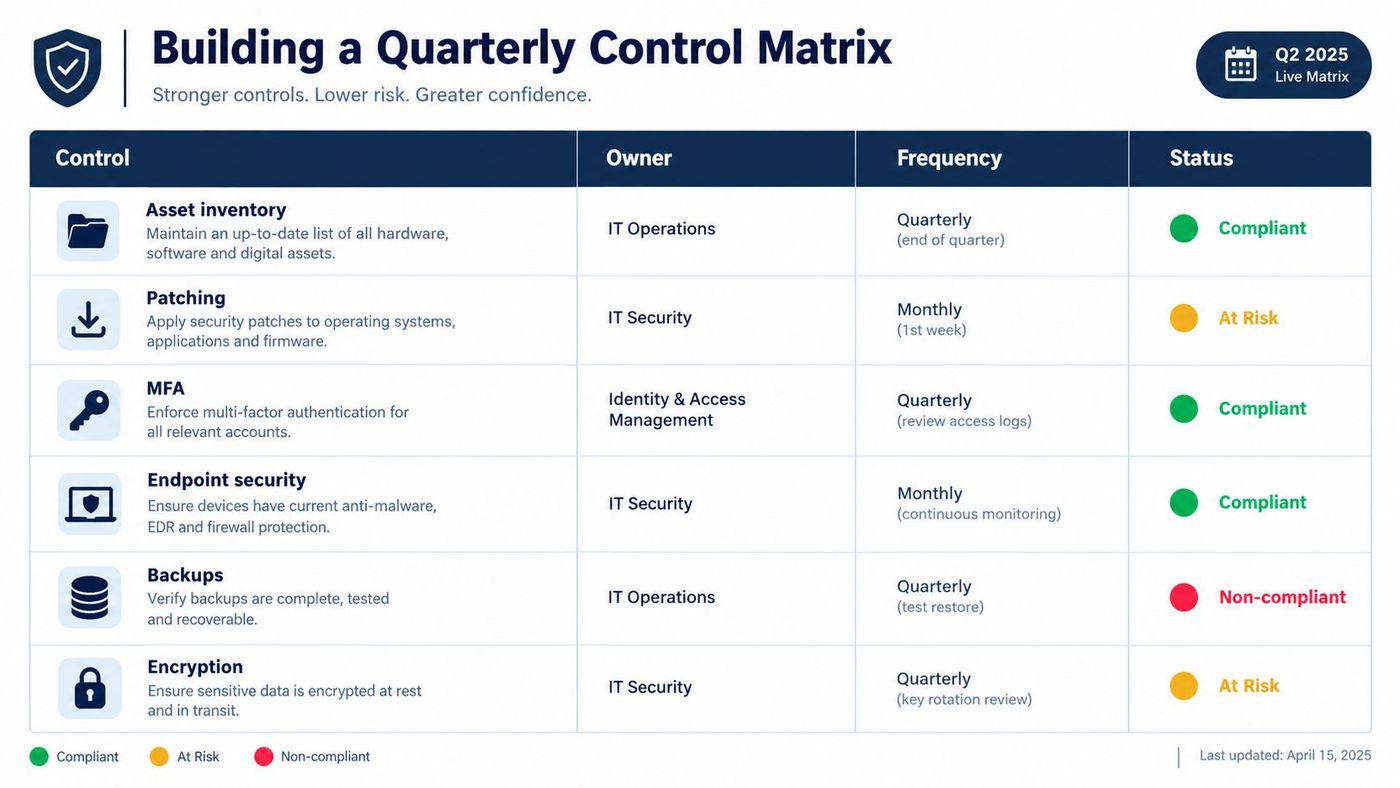
A clinic might emphasise intake systems, custodian access, and portable records. A manufacturer might emphasise shop-floor endpoints, remote vendor access, and backup isolation. The matrix stays the same. The evidence changes.
Practical rule: Every exception needs an expiry date. An exception without one quietly becomes your standard.
Business breaches are dominated by unauthorized access, with 78% of PIPEDA breach reports in 2025-26 involving unauthorized access, according to the OPC annual report for 2025-26. Federal incidents skew toward mishandling such as data-entry errors, misdirected correspondence, and labelling errors. Both patterns point at identity and workflow discipline, not just external hacking.
Map routine workflows end to end: Microsoft 365 sharing, email, printing, clinical intake, accounting exports, and vendor transfers. For each, record the likely failure mode, owner, preventive control, and test evidence. Set sharing to secure-by-default, limit external forwarding, and review excessive permissions before you buy anything new.
Short, scenario-based training works better than annual slide decks, especially when it's tied to real roles. Our resource on compliance training for employees shows how to structure that training by job function.
Report quarterly on misdirected-email events, excessive permissions, unresolved access-review exceptions, and time to revoke leavers. In distributed clinics, law firms, and logistics teams, accidental disclosure is often more probable than a targeted intrusion. Fix the workflow first.
One control matrix can satisfy several regulators if you map deliberately. Don't build separate programs for PIPEDA, PHIPA, OSFI, and Quebec obligations, then wonder why evidence is inconsistent. Our overview of Canadian data privacy laws helps teams see where duties overlap.

Under PIPEDA, you must report and notify when there's a real risk of significant harm and retain records of breaches. Under PHIPA, health information custodians must notify affected individuals when information is stolen, lost, or accessed without authority, and agents must notify the custodian, following IPC guidance on PHIPA breach notification. That requires separate agent-to-custodian, individual, and regulator workflows, plus pattern detection.
For federally regulated financial institutions, OSFI Guideline B-13 requires a formal technology and cyber risk framework with measurable appetite, limits, and thresholds, per OSFI technology and cyber risk management guidance. Translate that into board-approved thresholds for overdue vulnerabilities, privileged exceptions, and recovery objectives.
Quebec Law 25 adds provincial privacy governance duties. Map them to the same inventory, access, retention, and incident controls instead of running a parallel binder.
Under PIPEDA, when it's reasonable to believe a breach creates a real risk of significant harm, you report to the OPC, notify affected individuals, and keep a record of every breach involving personal information, including the ones you decide not to report, per OPC guidance on privacy breaches at your business. Counsel can weigh in on harm thresholds. Containment starts before counsel calls back.
The first breach report I've seen at a clinic wasn't a hacker. It was a referral emailed to the wrong patient, a routine handling error that still triggered the whole assessment.
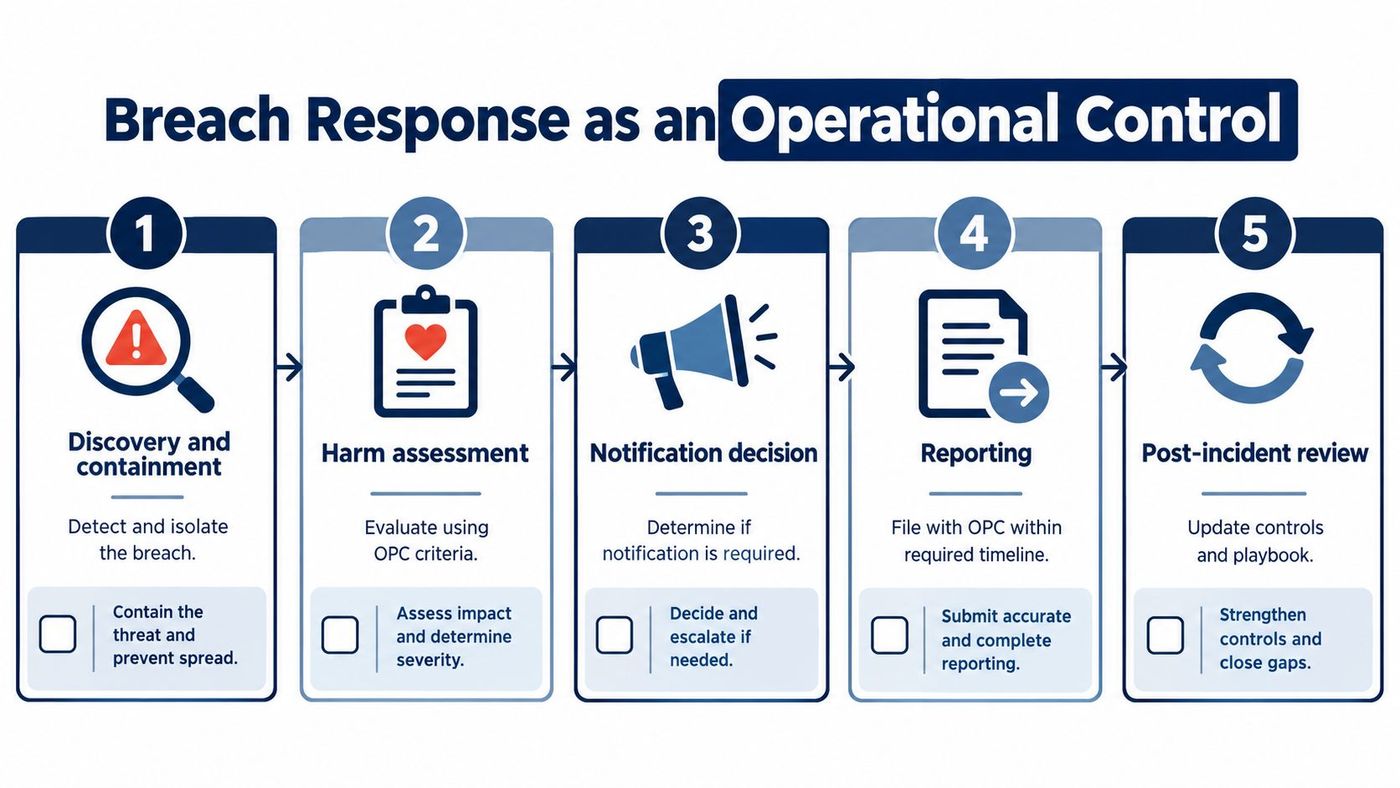
A breach playbook only counts as a control if it produces evidence an auditor or the OPC can inspect. Each stage should end with a record, not just an action.
| Stage | Operational action | Evidence to retain |
|---|---|---|
| Contain | Isolate affected accounts and systems, preserve logs | Timestamped, unedited incident timeline |
| Assess | Record data elements, people affected, and cause, including handling errors like misdirected email | Completed harm assessment |
| Decide | Reason through OPC, IPC, and individual notification duties separately | Signed notification decision with rationale |
| Report | Document timing, information compromised, numbers affected, and harm-reduction steps | Copy of each filed report |
| Review | Push corrective actions into the control matrix | Named owner and due date per action |
Run a tabletop before the actual event. Put the escalation path between the service desk and the client's privacy lead in writing, then track mean time to detect, mean time to contain, completed harm assessments, and notification-decision time. An untested playbook is shelfware.
A clinic hands its backups, endpoint patching, and Microsoft 365 tenancy to a provider. Months later, a helpdesk technician at that provider misconfigures a mailbox rule and patient details reach an outside account. The OPC does not call the provider first. It calls the clinic. Under PIPEDA's accountability principle and PHIPA's agent provisions, the organisation that collected the data answers for what its vendors do with it.
Contract terms decide how fast you learn about that mistake and how much evidence you can pull afterward. Permitted use, subprocessor lists, and data location define what the provider may do. Notification timing, audit rights, and evidence response deadlines define what it must show you. Backup retention, restore testing duties, and exit provisions covering data export and credential handover determine whether you can leave cleanly. Each clause functions as a control. Vague ones fail exactly when you need them.
The provider signs the contract. Your organisation signs the breach report.
CloudOrbis, for example, structures managed services around continuous monitoring and a Canada-based helpdesk, but clients still hold their own risk register, reassessment schedule, and approval authority. That split belongs in writing before onboarding. Our guide to third-party risk management in practice lists the questions worth asking every vendor, not just your MSP.
A quarterly test should make a control fail in daylight. Pick a small sample and trace it end to end: three departed users, one privileged account, one backup job, one vendor finding past due. If Microsoft 365 still lets a former staff member authenticate, or the restore misses its recovery point, record it as an exception with an owner and expiry date.
Statistics Canada found only 19.8% of Canadian businesses planned new or additional cybersecurity actions in the following year, while 47.6% planned none (Statistics Canada findings on business cybersecurity actions). I see the same pattern locally: written controls outnumber proven ones. Rotate validation across access reviews, restores, retention sampling, and a tabletop built around misdirected records or a compromised finance mailbox. Map evidence to Cyber Centre Baseline Controls, OSFI B-13 expectations, or PHIPA duties before audit season. Independent eyes help when internal teams mark their own homework; our security audit services overview shows how evidence should be organised. Send executives unresolved high-risk findings and remediation ageing each quarter.
You don't need a perfect program in a quarter. You need an operational one with real artefacts and a first test behind you.
Select the lead framework, confirm in-scope systems and exclusions, and build the asset and data inventory. Interview workflow owners in intake, finance, operations, and HR. Identify existing evidence in Microsoft 365, endpoint tools, and backup platforms.
Build the control matrix, assign owners, draft the breach playbook, and close obvious gaps such as missing MFA or stale privileged accounts. Complete a privacy impact assessment before launching major changes, consistent with OPC expectations for privacy impact assessments. Treat it as a stage gate, not paperwork after go-live.
Run your first access review, restore test, and tabletop exercise. Log exceptions with expiry dates and brief executives on residual risk. By day 90 you should have a register, matrix, playbook, assessment, and test results. That's a credible definition of done.
Hand this checklist to your vCIO, operations lead, or auditor as the minimum viable program.
Don't aim for more policies. Aim for fewer unverified claims.
Start with scope and ownership, then let the evidence drive spending. That sequence saves Canadian SMBs from buying tools that don't reduce the risks causing breaches.
Book a compliance risk assessment with CloudOrbis to turn this checklist into a working quarterly control matrix built for your sector, size, and Microsoft 365 environment. We'll map your current controls to PIPEDA, PHIPA, and relevant framework requirements, identify owner and evidence gaps, and prioritise fixes you can complete in 90 days. Visit CloudOrbis Inc. to get started.
Book a 30-minute call with a senior engineer. No sales script, just straight answers about your environment.


