SLA Monitoring for SMBs: A Practical Canadian Guide
Master SLA monitoring with practical KPIs, alerts, and tools tailored for Canadian SMBs. Learn compliance best practices and avoid common pitfalls.

Master SLA monitoring with practical KPIs, alerts, and tools tailored for Canadian SMBs. Learn compliance best practices and avoid common pitfalls.
A cloud platform fails during a client meeting. Staff switch between applications, customers wait for updates, and the IT team starts calling vendors. By the end of the incident, everyone knows something went wrong, but nobody can clearly prove when the failure began, which provider owned each part of the service, or whether the contract provides a remedy.
That gap is where SLA monitoring earns its place. It turns a service promise into an observable process, with agreed definitions, reliable timestamps, escalation rules, and evidence that stands up during a vendor review or audit. For Canadian small and mid-sized businesses, the practical challenge isn't just tracking uptime. It's connecting technical measurements to business continuity, contractual accountability, and regulatory obligations.
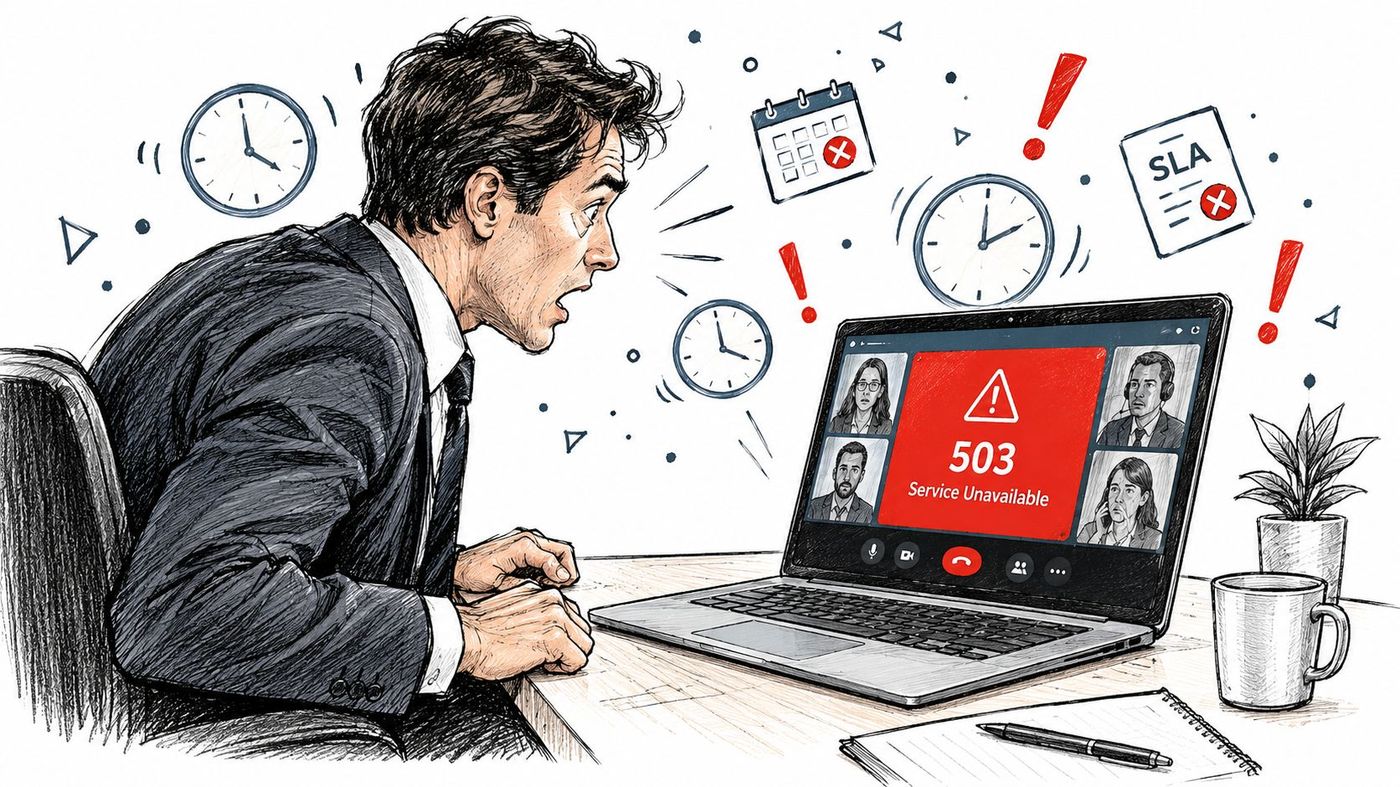
A service outage creates more than lost access. Your team may miss a customer commitment, delay a shipment, lose a transaction, or spend hours reconstructing events from scattered email threads. If a managed provider later disputes the breach, a dashboard screenshot without timestamps, measurement rules, and incident records may not be enough.
SLA monitoring provides the safety net. It measures services against the commitments in an agreement, alerts the right people when performance drifts, and preserves an operational record that supports investigation. The agreement might cover availability, response time, repair time, accuracy, accessibility, or client satisfaction. Monitoring makes those terms visible instead of leaving them as promises reviewed after the damage is done.
Canadian public-sector practice shows how formal this discipline can become. Shared Services Canada reported cloud brokering performance of 99.77% in 2023-24, compared with 99.17% in 2022-23 and 99.65% in 2021-22, against a target of 90%. Its external network connectivity availability reached 99.93% in 2023-24, against a 99.5% target. These results, and the accompanying monthly compliance approach, show that service measurement can be an operating discipline rather than a theoretical exercise. (Shared Services Canada's departmental results report)
Practical rule: If you can't show when an incident started, how you measured it, and who acted on it, you don't yet have dependable SLA evidence.
A practical monitoring programme also changes the relationship between IT and leadership. Instead of discussing whether systems “seem stable,” managers can review service health, recurring incidents, vendor responsiveness, and unresolved risks. Guidance from the federal government defines service level management as an ongoing process to collect requirements, measure service, improve it, and sustain quality within agreed commitments. (Government of Canada service management guidance)
For organisations reviewing their support model, IT and network support guidance can help connect monitoring responsibilities with the wider operating model.
A useful SLA dashboard starts with the contract, not the monitoring product. Each commitment needs a clear metric, a measurement period, defined start and stop events, exclusions, an owner, and a reporting method. Without those definitions, two parties can collect accurate data and still reach different conclusions.
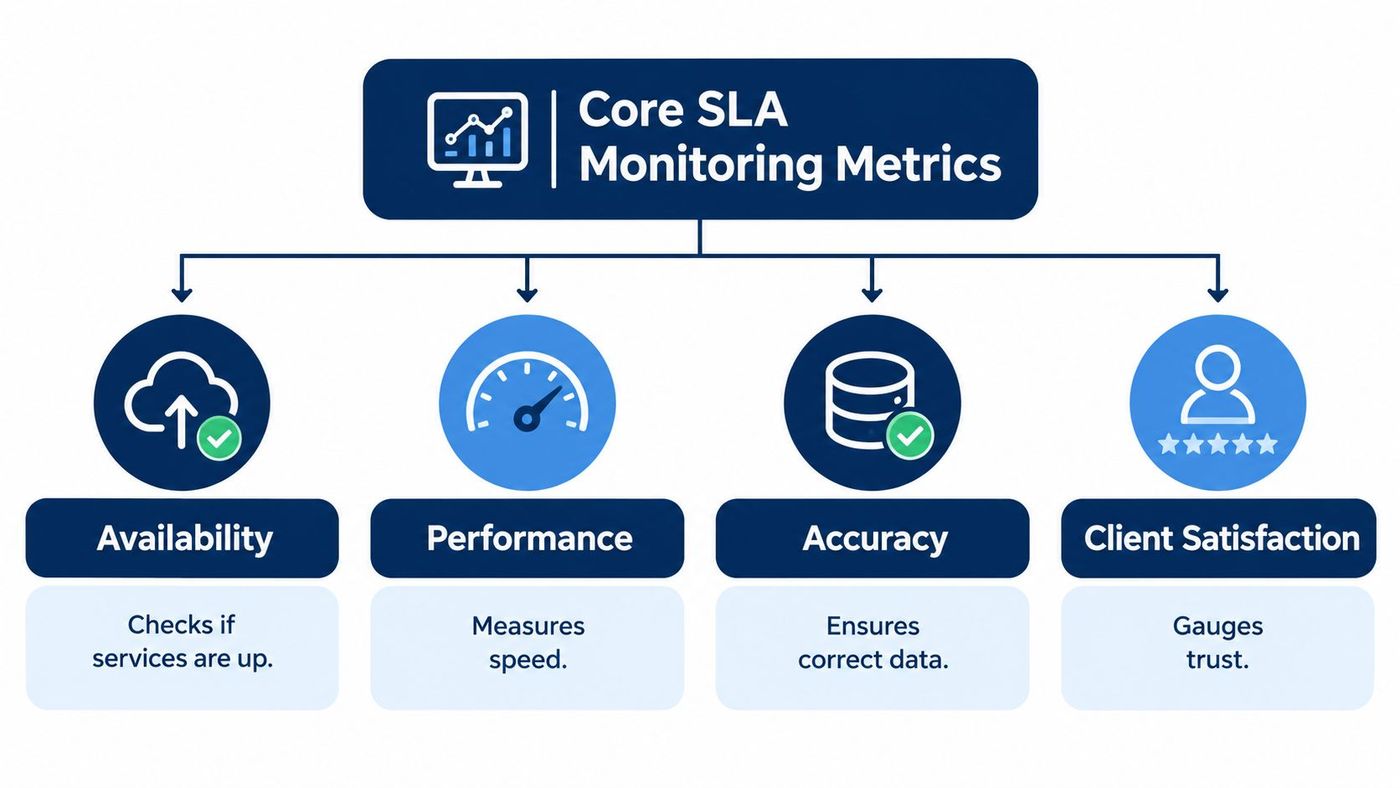
Availability asks whether the service can be used during agreed service hours. A federal procurement document defines availability as:
(measurement period minus outage time) divided by the measurement period, multiplied by 100
The same document specifies a subscription service availability target of at least 99.900% and requires contractors to monitor, measure, calculate, and report service levels 24/7/365. It also sets a service desk target of answering 80.0% of calls within 20 seconds. (Shared Services Canada statement of work)
Availability alone can mislead. A server may respond to a basic health check while users can't authenticate, complete a payment, access a document, or place an order. Test the functions that matter to the business, not only the infrastructure underneath them.
Performance covers how quickly and consistently a service responds. Depending on the agreement, it may include application response time, service desk response, recovery time, repair time, or processing throughput. Ontario's GO-ITS 41 standard says service levels should be reported with both current and trend information, and notes that availability targets are commonly expressed as a percentage of agreed service hours, such as 99.98% availability. (Ontario GO-ITS 41 service level management standard)
Accuracy measures whether the service produces the correct result. An available finance application that posts an incorrect value is operationally unhealthy, even if every page loads quickly. Include transaction validation, reconciliation checks, and error classification where data quality affects customers or compliance.
Satisfaction captures the experience that technical telemetry may miss. Track structured feedback alongside incidents, response records, accessibility, and recurring complaints. The practical network monitoring guidance can help teams connect infrastructure signals with the user experience.
Alerts work only when someone knows what they mean and what to do next. A notification that says “service degraded” without an owner, impact statement, or escalation deadline adds noise during an already difficult incident.
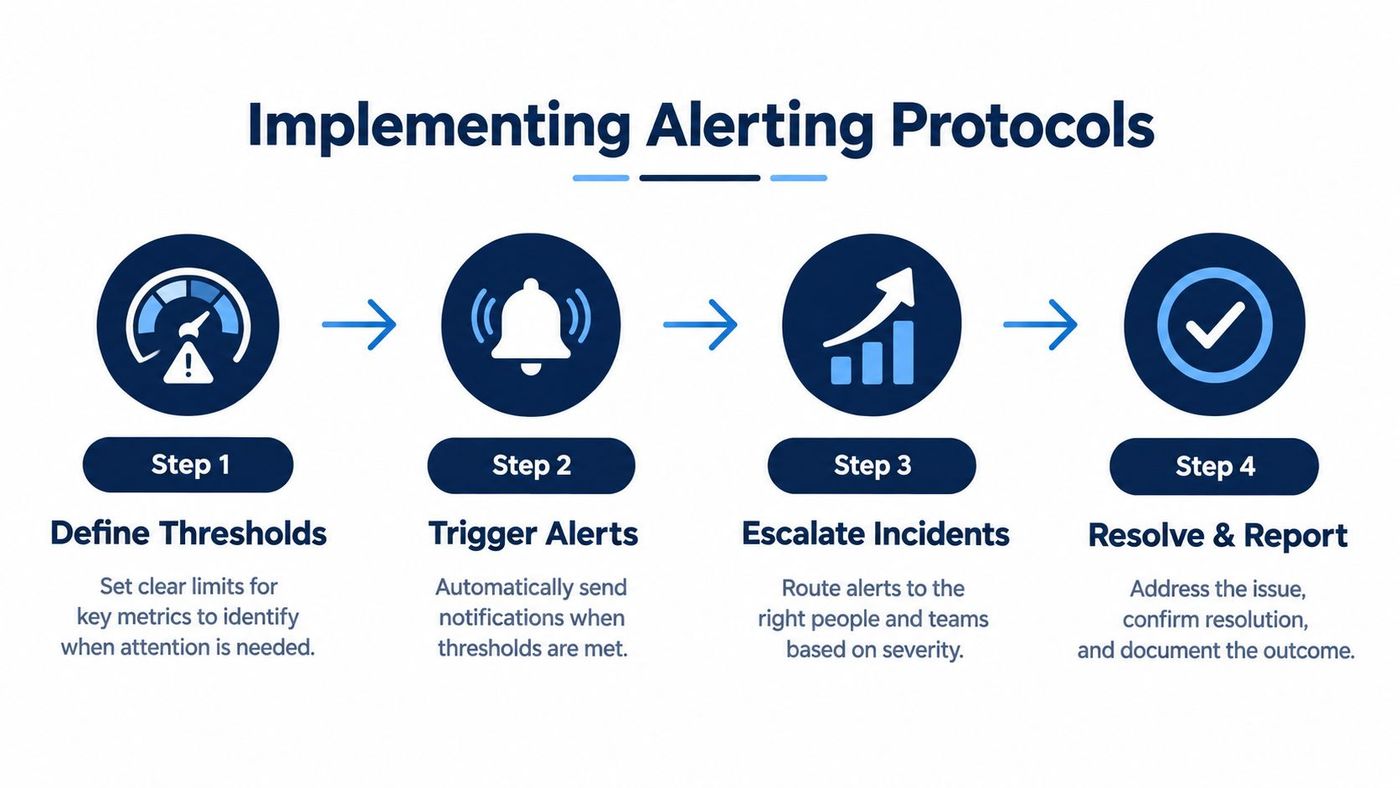
Use a simple four-step operating pattern.
Don't alert everyone to everything. Route warnings to the team that can act, reserve critical escalation for material risk, and review alerts that repeatedly produce no action.
Test the process with realistic scenarios, including a dependency failure and a partial service degradation. Tier 1 support guidance can help clarify which issues should be handled at the first support level and which require specialist escalation.
A monthly SLA report shouldn't be a colour-coded scorecard that nobody discusses. It should explain what changed, why it changed, what the business experienced, and which decision follows.
Start with trend analysis. Compare current performance with previous reporting periods, then group incidents by service, cause, vendor, location, and business process. A recurring authentication failure may require identity work, while repeated network latency may point to capacity, routing, or a third-party dependency. The metric identifies the pattern. The incident record supplies the context.
Canada's Treasury Board Guideline on Service Agreements says monitoring should include audit activities that verify key terms are being fulfilled. It also identifies common target areas including availability, recovery and repair time, end-user response time, accuracy, accessibility, and client satisfaction. (Treasury Board Guideline on Service Agreements)
Review these findings with the people who own the outcome, not only the monitoring platform. A service owner can decide whether to change a supplier, adjust capacity, revise a support workflow, or accept a documented risk. A business leader can see whether the technical issue affected revenue, customer commitments, staff productivity, or compliance.
The analytics and reporting guidance is useful when you need to turn operational records into reports leadership can act on.
SMBs usually choose between building a monitoring stack themselves, buying a managed service, or combining both. The right choice depends less on the number of dashboards and more on who will interpret alerts, preserve evidence, maintain integrations, and respond outside business hours.
| Approach | Best For | Key Considerations |
|---|---|---|
| Self-hosted monitoring | Teams with in-house technical ownership and integration skills | Greater control and customisation, but your staff manage updates, alert tuning, availability of the monitoring platform, and escalation coverage |
| Cloud monitoring platform | Businesses needing fast deployment across cloud applications and infrastructure | Easier scaling and broad integrations, but confirm data residency, retention, access controls, export options, and vendor service terms |
| Managed monitoring service | SMBs without round-the-clock operational coverage | Provider handles alert triage and escalation, but contracts must define responsibilities, evidence access, reporting, and dependency boundaries |
| Hybrid model | Organisations with internal application owners and external infrastructure support | Offers flexibility, but unclear ownership between teams can create gaps during incidents |
Evaluate vendors through a live demonstration rather than a feature checklist. Ask the provider to show how it detects a partial failure, records the first observation, opens a ticket, escalates an unacknowledged alert, and produces a report. Confirm whether synthetic checks can test real business transactions and whether the data can support a vendor dispute.
The managed services questionnaire provides a useful structure for examining coverage, responsibilities, security, reporting, and response practices.
CloudOrbis Inc. is one Canadian managed IT option that provides monitoring and alerts for networks, servers, and critical applications, alongside helpdesk, cybersecurity, cloud, backup, and strategic IT services. Compare those capabilities with internal capacity and the specific evidence requirements in your agreements.
Regulated organisations need more than an uptime percentage. Healthcare providers, manufacturers, and legal firms must be able to explain who accessed systems, what happened during an incident, how the organisation responded, and whether records were preserved.
For healthcare, monitoring should support privacy, security, availability, and continuity requirements. Canadian organisations may also work with PIPEDA and provincial privacy rules, while some teams use HIPAA-aligned controls when serving clients or partners with United States obligations. Don't assume that a compliance label proves coverage. Map each requirement to a control, an owner, a log source, a retention rule, and an evidence review process.
Manufacturers should connect SLA monitoring to production technology, warehouse systems, voice services, identity platforms, and supplier dependencies. A short failure in a scheduling or production system may create operational consequences even when the wider network remains available. Legal practices need similarly careful treatment of matter data, collaboration systems, remote access, and audit trails, because confidentiality and evidence integrity matter alongside service continuity.

The reporting clock can also extend beyond the contract. The CRTC requires telecommunications service providers to notify the Commission and government authorities of major outages, including a confidential notification within two hours of awareness and a detailed post-outage report within 14 days. It defines a primary service outage at 600,000 user-minutes or higher. (CRTC major outage reporting requirements)
That creates a practical evidence question for any organisation using several providers: what proves when the outage was first detected, when the reporting clock began, and which party owned the notification? Keep synchronised timestamps, monitoring events, tickets, communications, vendor notices, and post-incident decisions together. Cybersecurity guidance for managed services also supports collecting and retaining system, network, firewall, and event logs, with baselines and correlation used to identify anomalous activity. (Canadian Centre for Cyber Security managed services guidance)
A good dashboard answers three questions quickly: Is the service meeting its commitment? Is risk increasing? Who needs to act? It shouldn't force an executive to interpret raw logs or make a technical team hunt through a presentation for the affected service.
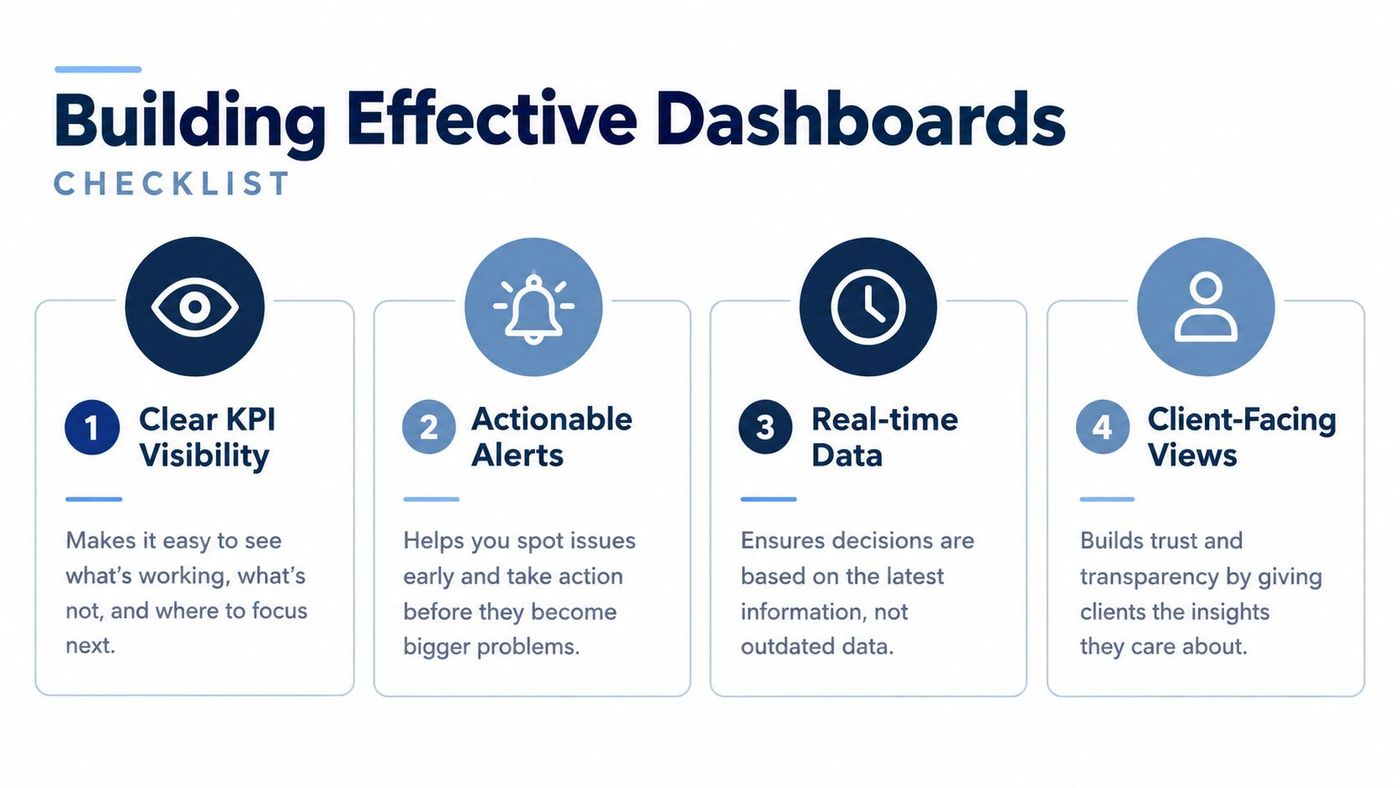
Build the dashboard in layers.
Reports should define the measurement window and exclusions directly beside each result. Include a short narrative for every breach or material trend, with the responsible owner and next action. A report that records failure without an owner is an archive, not a management tool.
A dashboard is successful when it shortens a decision, not when it displays more data.
Use current and trend information together. Ontario's service level management standard supports this approach, while federal SLA audit material emphasises tracking delivery, resolving SLA-related issues, and using findings to drive continuous improvement. (House of Commons SLA audit material)
For SMBs, the next step is practical. Review your most important services, confirm how each SLA is measured, assign every alert and escalation to a named owner, and test whether your records would prove the timeline during a dispute or audit. CloudOrbis Inc. can assess your monitoring, support escalation, cybersecurity, cloud, backup, and reporting needs, then help build a more accountable operating model. Visit CloudOrbis Inc. to discuss how your organisation can monitor service performance, preserve outage evidence, and respond before technical problems become business interruptions.
Book a 30-minute call with a senior engineer. No sales script, just straight answers about your environment.


