A Guide to IT Services in Edmonton for Growing Businesses
Discover the essential IT services in Edmonton that drive growth and security. Our guide covers service types, compliance, and choosing the right IT partner.

Discover the essential IT services in Edmonton that drive growth and security. Our guide covers service types, compliance, and choosing the right IT partner.

In Edmonton’s thriving economy, relying on a reactive break-fix IT model is a risk few medium-sized businesses can afford. Leading IT services in Edmonton act not just as problem-solvers but as strategic partners. They build resilient technology foundations that prevent issues and fuel growth.
Adopting this proactive approach distinguishes thriving companies from those that merely survive.

Leaders of medium-sized organisations now view IT as more than a necessary cost centre. It has become a powerful engine for efficiency and growth, driven by opportunities in Edmonton’s business scene.
From scaling operations in manufacturing and logistics to safeguarding sensitive client data, waiting for tech failures invites costly downtime, lost productivity and reputational harm. A forward-thinking IT strategy is no longer optional, it’s essential for survival.
Think of a reactive IT setup as a firefighter, always on call to address the latest crisis, keeping you in a constant state of emergency. A strategic IT partner acts like a digital architect.
Instead of merely fixing problems, they design a secure, scalable technology infrastructure that anticipates future needs and prevents issues. This approach lets you focus on core business goals, confident that your technology is an asset, not a liability. For more depth, see our guide on IT strategy and consulting.
A proactive IT partnership goes beyond keeping the lights on. It creates a blueprint for growth, security and operational excellence tailored to the local economic landscape.
As Edmonton businesses rethink their IT approach, finding the right funding is often part of the puzzle. Resources like Information Technology grants can offer a boost for new projects. Teaming up with a provider who knows the Edmonton landscape is the first step toward a smart, strategic move for your company’s future.
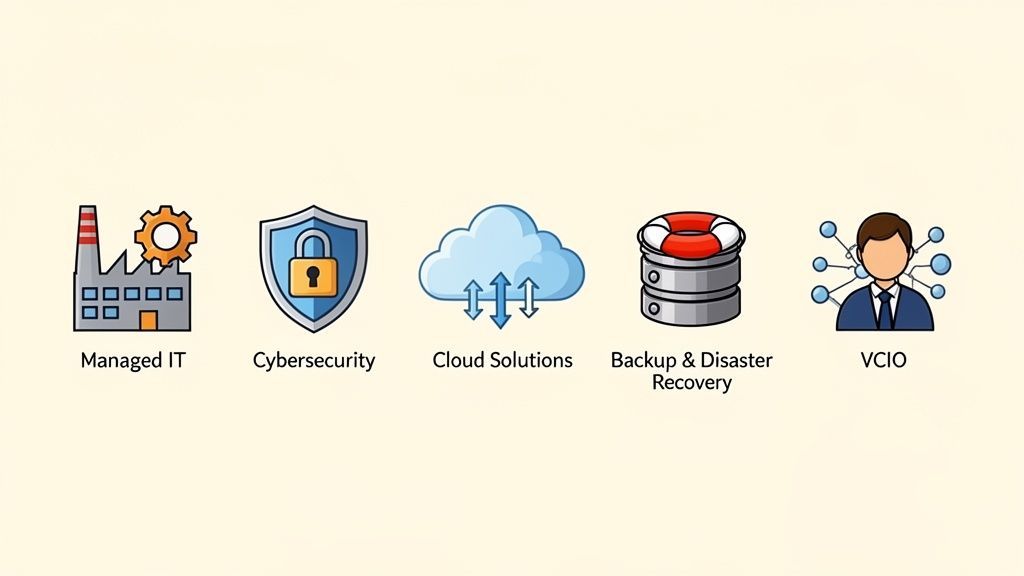
Choosing the right IT support can feel like a maze of jargon. Let’s cut through the noise. We’ll link each service to real-world scenarios in Edmonton so you can see how they solve everyday business headaches.
Below, we break down the five pillars of modern IT support, showing how each helps local companies protect operations, work smarter and prepare for what’s next.
| Service Type | Primary Benefit | Ideal For (Edmonton Business Type) |
|---|---|---|
| Managed IT Services | Proactive system maintenance and predictable IT costs. | Any business that can't afford downtime (e.g., manufacturing, professional services). |
| Cybersecurity Services | Protection against data breaches, ransomware, and financial loss. | Businesses handling sensitive data (e.g., legal, financial, healthcare). |
| Cloud Solutions | Scalable, flexible access to data and applications from anywhere. | Companies with fluctuating demand or remote teams (e.g., logistics, construction). |
| Data Backup & Disaster Recovery | Rapid recovery from data loss or system failure. | All businesses; it’s your ultimate operational safety net. |
| Strategic IT Consulting (vCIO) | Long-term technology planning aligned with business goals. | Growing businesses that need expert guidance without a full-time executive salary. |
Imagine you run a busy manufacturing facility in Nisku. Every minute of downtime costs thousands in lost revenue and delayed orders. This is where Managed IT Services prove their value.
A managed services provider (MSP) monitors your systems 24/7, spotting and fixing potential issues before they cause downtime. They handle network monitoring, software updates and day-to-day helpdesk support, freeing you to focus on production targets.
Think of managed IT as having a dedicated team of engineers ensuring your digital infrastructure runs smoothly, securely and efficiently, for a predictable monthly cost.
Picture a downtown financial advisory firm. Your most valuable asset isn’t office space, it’s client trust. A single breach can destroy that trust.
Cybersecurity Services go beyond antivirus software. Providers build a multi-layered defence:
For Edmonton businesses in finance, legal and healthcare, strong cybersecurity is a business imperative.
Consider a logistics company facing seasonal demand swings. Peak season needs more computing power; quieter months require less.
Cloud Solutions from providers like Microsoft Azure or AWS let you scale resources on demand with a pay-as-you-go model. You avoid large capital investments in on-site servers and give your team secure access to applications and data from anywhere.
Edmonton’s IT services market quickly adopts modern cloud solutions. Canada’s national IT services sector is projected to grow from USD 60.08 billion in 2025 to USD 128.46 billion by 2030. Learn more at Canada’s evolving IT services market.
Disasters strike without warning, ransomware attacks, burst pipes in server rooms. Backup and Disaster Recovery (BDR) services ensure rapid recovery.
A robust BDR plan backs up your entire IT environment, servers, applications and data, to a secure off-site location. After an incident, you restore operations quickly, minimising financial loss and reputational damage. Think of it as an insurance policy for your digital assets.
As you grow, your technology must evolve. A Virtual Chief Information Officer (vCIO) gives you strategic guidance without the cost of a full-time executive.
Your vCIO collaborates with leadership to build a technology roadmap aligned with business goals. They help budget for IT investments, navigate compliance, and turn technology into a competitive advantage. Growing businesses benefit from vCIO expertise, see our guide on managed IT services in Edmonton for more.
Compliance isn’t just a checkbox, it’s critical for staying in business. Non-compliance can trigger fines, reputational damage and operational shutdowns. The right IT partner navigates this landscape, ensuring your infrastructure meets industry regulations from the ground up.
Healthcare practices face strict laws: the Personal Information Protection and Electronic Documents Act (PIPEDA) and Alberta’s Health Information Act (HIA). These regulations dictate how patient data is collected, stored and shared.
Your IT must include:
Working with an IT provider versed in HIA and PIPEDA keeps your clinic compliant, protecting patients and your practice.
Legal and financial firms guard highly confidential client information. Data sovereignty requires certain data to stay on Canadian soil.
Your IT provider must offer secure, Canada-based data centres and robust protocols such as multi-factor authentication, 24/7 network monitoring and regular vulnerability scans. These measures fend off breaches and maintain client trust.
Construction and manufacturing firms may not face the same mandates as healthcare but they must safeguard trade secrets, blueprints, proprietary processes and project plans.
A breach could enable corporate espionage or shutdown operations. Your IT provider should secure your internal network and project files, preventing unauthorised access. For legal setup, refer to our practical guide to incorporation in Alberta and explore our compliance solutions tailored to your industry.
Choosing a partner for your IT services in Edmonton is a strategic decision, not a technical one. The right provider seamlessly integrates with your team, boosting efficiency and security. The wrong choice can lead to downtime and headaches. This guide helps you move past sales pitches to find a confident match.
The Service Level Agreement (SLA) outlines your relationship with the IT provider. Read beyond buzzwords.
A “99.9% uptime” guarantee still allows almost 8.8 hours of downtime per year. Ask:
A “4-hour response time” means ticket acknowledgement, not resolution. Request average resolution times by severity.
Support models vary. You need prompt assistance from a team familiar with Edmonton’s business scene, not a distant call centre.
A local, 24/7 helpdesk ensures critical issues on a holiday weekend get immediate attention, not just logged for the next business day.
Ask about support channels, phone, email and client portal. CloudOrbis offers a one-click “IT Button” for instant help, minimising downtime.
Your IT provider is your first line of defence against cyber threats. Verify their security credentials, like SOC 2 Type II certification.
Also ask about their internal security practices: Do they run regular vulnerability assessments and penetration tests? A provider serious about its own security is more likely to protect yours.
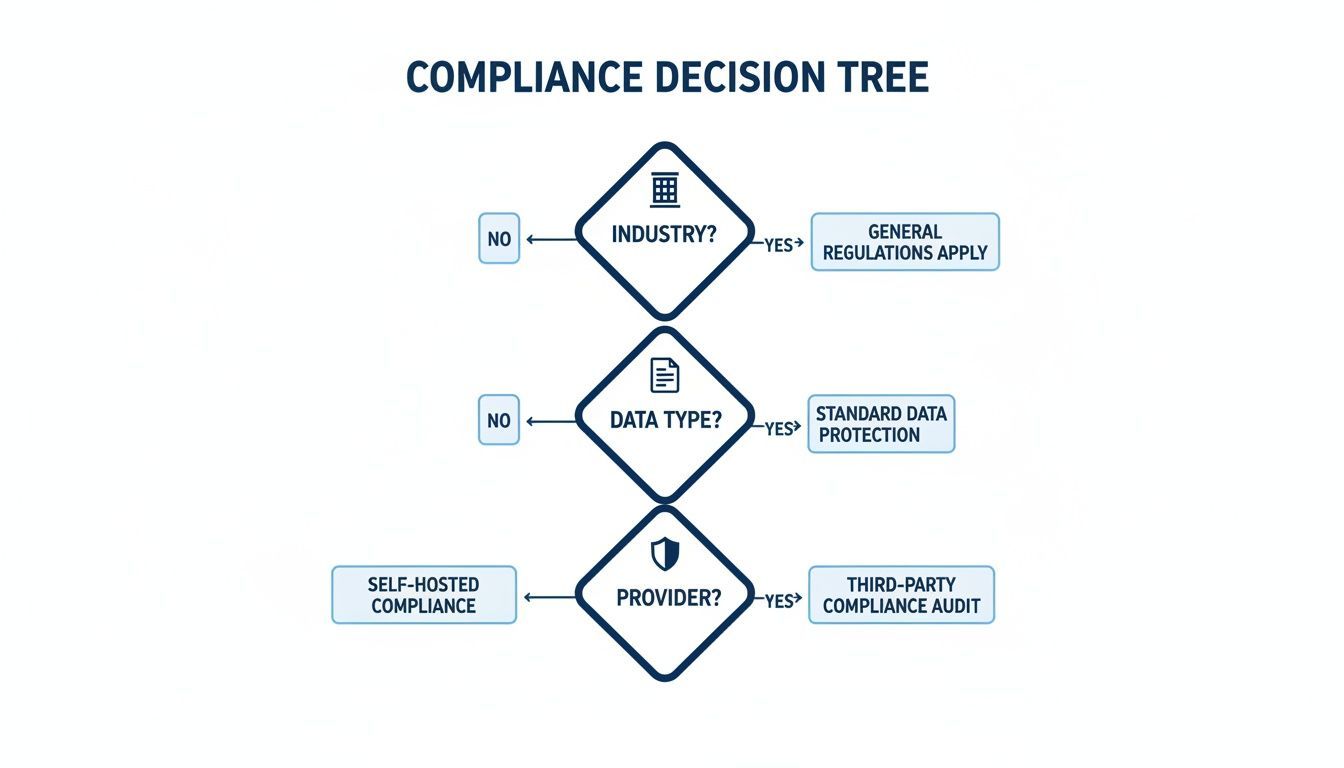
The flowchart below helps match a provider’s verified skills to your operational and regulatory needs.
| Evaluation Criteria | Provider A | Provider B | CloudOrbis |
|---|---|---|---|
| SLA: Uptime Guarantee | 99.9% Financially Backed | ||
| SLA: Time-to-Resolution | Industry-Leading | ||
| Support: Local Helpdesk | Yes, 24/7/365 | ||
| Support: Response Channels | Phone, Email, IT Button | ||
| Security: SOC 2 Certified | Yes, SOC 2 Type II | ||
| Expertise: Microsoft Partner | Yes, Solutions Partner | ||
| Experience: Local Case Studies | Available on Request | ||
| Pricing: Model | Fixed, All-Inclusive |
Ensure the provider has experience with your technologies. If you run Microsoft 365, ask for case studies or references from Edmonton businesses. Local expertise matters, it speeds on-site support when needed.
Alberta’s IT consulting industry is projected to hit $8.4 billion by 2026, driven by SMBs investing in technology. See a detailed market analysis from IBISWorld for more. For deeper insights, check our guide on IT consulting in Edmonton.
The financial and logistical side of hiring a managed IT partner can feel daunting. A transparent provider makes costs predictable and the onboarding process clear, ensuring a smooth transition.
Choosing the right pricing model aligns with your budget and operations, eliminating surprise invoices:
The optimal model offers a fixed monthly fee that covers everything you need. This turns IT from an unpredictable expense into a stable operating cost.
Demand for IT services in Edmonton is part of a larger trend, Canada’s ICT market aims for USD 206.47 billion by 2031, driven by cloud adoption. Learn about trends shaping Canada’s ICT market.
Switching IT providers shouldn’t disrupt daily operations. A structured onboarding process ensures minimal impact:
This phased approach makes the move to superior managed IT support services a smooth, positive step forward.
This guide shows that choosing an IT provider is a business decision, not just a technical one. A proactive partner anticipates issues, strengthens security and drives operational efficiency. They align with your vision and invest in your success.
Choosing an IT provider means finding a team as committed to your goals as you are.
Start with a conversation. A complimentary, no-obligation consultation with our local experts will assess your IT systems and outline how a strategic partnership can accelerate your growth. Book your consultation today and build the technology foundation you need to focus on what you do best.
Ready to partner with a team that offers strategic, proactive IT services in Edmonton? Contact CloudOrbis Inc. for a complimentary consultation to see how we can help your business grow with confidence.
As a rule of thumb, small to medium-sized businesses in Edmonton allocate between 3% and 6% of annual revenue to technology. The precise amount depends on:
A quality provider offers a predictable, fixed monthly fee, eliminating surprise bills and simplifying financial planning.
Choosing solely on price is the biggest mistake. The lowest bidder often offers a reactive "break-fix" model, leading to hidden costs from downtime, lost productivity and potential breaches. Prioritise value: guaranteed response times, proactive maintenance and strategic guidance yield a better return on investment.
Transitioning to a managed service typically takes 30 to 90 days. A structured project approach, starting with discovery, followed by planning, after-hours implementation and team training, ensures minimal disruption. A well-managed process makes the switch feel seamless.
Yes. While remote support resolves over 95% of issues quickly, some situations require on-site expertise, hardware failures, complex network issues or critical emergencies. A local team ensures fast, hands-on support whenever you need it, providing comprehensive coverage.
Book a 30-minute call with a senior engineer. No sales script, just straight answers about your environment.


