Quality of Service Setup for SMB Networks
Plan a quality of service setup for your SMB network. Learn DSCP/PHB, traffic prioritization, sample configs, and verification for VoIP, Teams, and more.

Plan a quality of service setup for your SMB network. Learn DSCP/PHB, traffic prioritization, sample configs, and verification for VoIP, Teams, and more.

A clinic's Teams call starts to break up just as a physician opens an electronic health record. In a law office, a document-management sync saturates the connection while a client waits on a VoIP call. On a factory floor, a cloud dashboard becomes sluggish whenever the backup window begins. Each incident looks different, but the underlying problem is often the same: the network has capacity, yet it has no agreed way to protect the traffic that matters most.
A practical quality of service setup turns that uncertainty into measurable policy. It identifies applications, classifies traffic, reserves treatment for latency-sensitive services, and proves whether the change improved service. The router configuration matters, but it's only the visible part of a larger discipline involving monitoring, escalation, supplier accountability, and operational ownership.
More bandwidth doesn't automatically produce better service. Statistics Canada's CRTC-based indicator shows that 96.4% of Canadian households had access to broadband at 50 Mbps download and 10 Mbps upload in 2024, up from 86.0% in 2018 (Statistics Canada's quality-of-life indicator). Yet the CRTC reported that only 56% of Canadians agreed their Internet service was reliable (CRTC 2025 Communications Market Report).
That gap is familiar to anyone supporting a distributed SMB. A link can test fast while calls jitter, VPN sessions stall, and cloud applications pause under load. Quality of service starts by measuring those symptoms, then deciding which traffic deserves protection.

The remedy isn't to activate every vendor preset. First, capture application performance during normal and busy periods. Then identify whether the bottleneck sits in Wi-Fi, the LAN, the firewall, the WAN circuit, or the ISP handoff. Organisations involved in physical connectivity projects may also benefit from understanding wireline and wireless network construction, particularly when a service upgrade depends on external plant or last-mile work.
When nothing changes, staff compensate manually. They turn cameras off, retry uploads, move calls to mobile phones, and delay backups. Those workarounds hide the failure while increasing operational risk. A proper setup replaces anecdotal complaints with service objectives, evidence, and a named owner for every missed target.
QoS terminology looks intimidating until you follow one packet. A VoIP packet leaves a desk phone, enters a switch, receives a classification, carries a marking across the network, joins a queue, and is forwarded according to a defined treatment. Each stage answers a different question.
Classification identifies the traffic. The switch might recognise a voice VLAN, a trusted phone port, an application signature, or a known source and destination. Marking assigns a value that travels with the packet. DSCP, or Differentiated Services Code Point, is the common marking field.
PHB, or Per-Hop Behaviour, describes what a router or switch should do with that mark. A device may place voice in a low-delay queue, give business applications a weighted queue, and leave bulk transfers in best effort. Policing enforces a ceiling by discarding or remarking traffic that exceeds an allowance. Shaping buffers and releases traffic at a controlled rate, usually to prevent bursts from overwhelming a slower WAN interface.
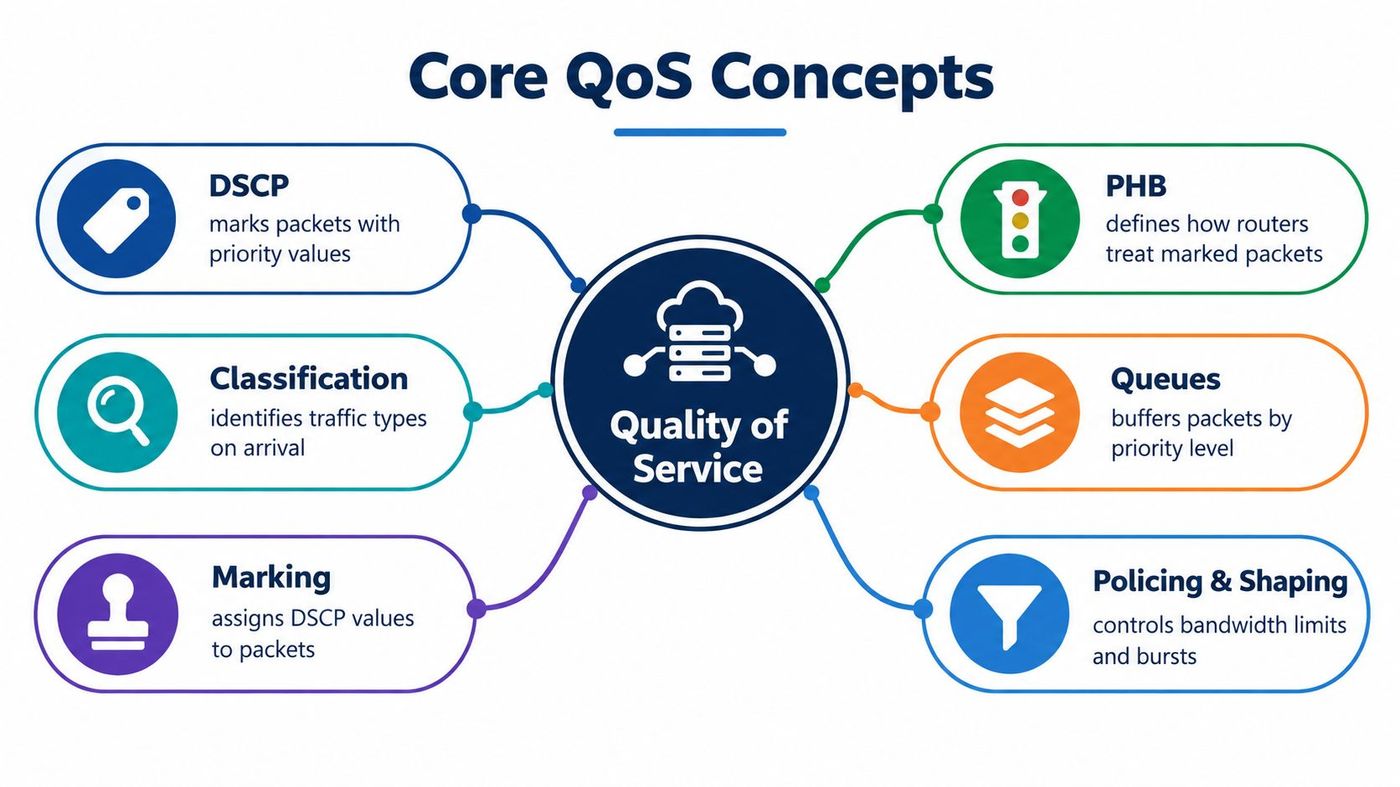
The useful mental model: QoS is policy expressed in packets.
The marking must be trustworthy. A phone port can mark voice traffic at the access layer, but an unmanaged guest device shouldn't be allowed to claim priority. That's why the trust boundary matters. Mark close to the source when possible, trust only approved interfaces, and re-mark traffic that arrives from untrusted networks.
Shaping at the WAN edge still matters, especially when the provider's available rate is lower than the physical interface rate. But shaping can't repair an incorrect classification or a congested wireless hop. It also can't fix an application that ignores network markings. For broader segmentation decisions, the principles in what network segmentation means for business networks provide useful context.
Microsoft 365 traffic adds another complication. Endpoint and application behaviour may not preserve the markings an older template expects, so teams must validate packets rather than assume that a default policy matches current traffic. The leadership-level question is simple: which applications get preferential treatment, why, and what evidence will show that the choice worked?
The strongest QoS plans begin with an application inventory, not a manufacturer's drop-down menu. List every service that crosses the network, identify its operational consequence, and document what happens when it experiences delay, loss, or a complete outage.
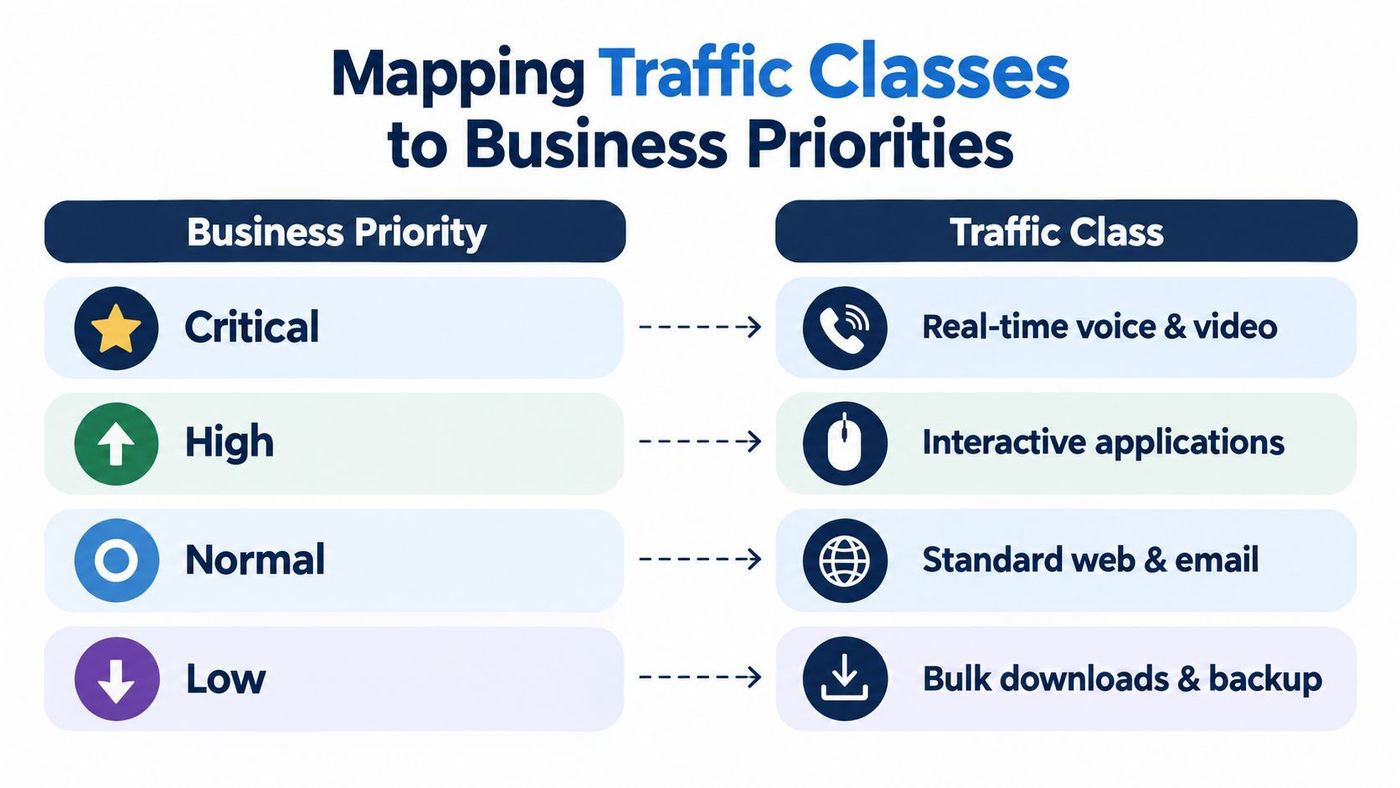
A clinic may put voice, telehealth video, electronic records, imaging exchange, security telemetry, and backups on the same worksheet. A manufacturer may add ERP transactions, production dashboards, machine data, remote support, and software distribution. A law firm may prioritise voice, document management, case databases, MFA traffic, and court-related collaboration.
Healthcare requires particular care because traffic importance isn't always visible to a firewall. In 2024, 92% of Canadian healthcare providers had access to a digital health system, while 52% used one to share patient clinical information electronically with providers outside their main practice (Statistics Canada). Encrypted clinical traffic may look like ordinary TLS, so classification may need application awareness, source context, destination policy, or a reservation for a known service rather than a simple port rule.
The CRTC's approach offers a useful operational precedent. Federally regulated telephone companies report against 16 service-quality indicators each quarter, explain missed standards, and identify remedies (CRTC quality-of-service framework). An SMB doesn't need to reproduce that regulatory model, but it should adopt the same habits: defined objectives, regular review, exception reporting, and corrective action.
| Traffic Class | Examples | Recommended DSCP / PHB | Why It Matters |
|---|---|---|---|
| Real-time voice | Teams Phone, SIP, desk phones | EF, DSCP 46 | Protects delay and jitter-sensitive conversations |
| Real-time video | Teams meetings, telehealth video | AF41, DSCP 34 | Preserves interactive video without treating all large transfers as urgent |
| Interactive business applications | EHR, ERP, document management, VPN | Assured-forwarding class selected by policy | Keeps staff-facing transactions responsive |
| Bulk transfer | Backups, file replication, software distribution | Scavenger or controlled best effort | Prevents background work from consuming interactive capacity |
| Best effort | Guest Wi-Fi, general web, non-critical sync | Default best effort | Uses remaining capacity without bypassing policy |
Treat this table as a hypothesis, not a finished design. Confirm each class with packet captures, vendor requirements, and business owners. Don't give every encrypted flow the same priority because it supports a critical department. Reserve enough capacity for endpoint security, logs, updates, and recovery traffic, or the network may appear fast during normal use while becoming exposed during an incident.
The menus differ across platforms, but the policy remains portable. Define the trust boundary, classify approved traffic, map markings to queues, reserve treatment for real-time services, and shape the WAN egress to the usable provider rate.
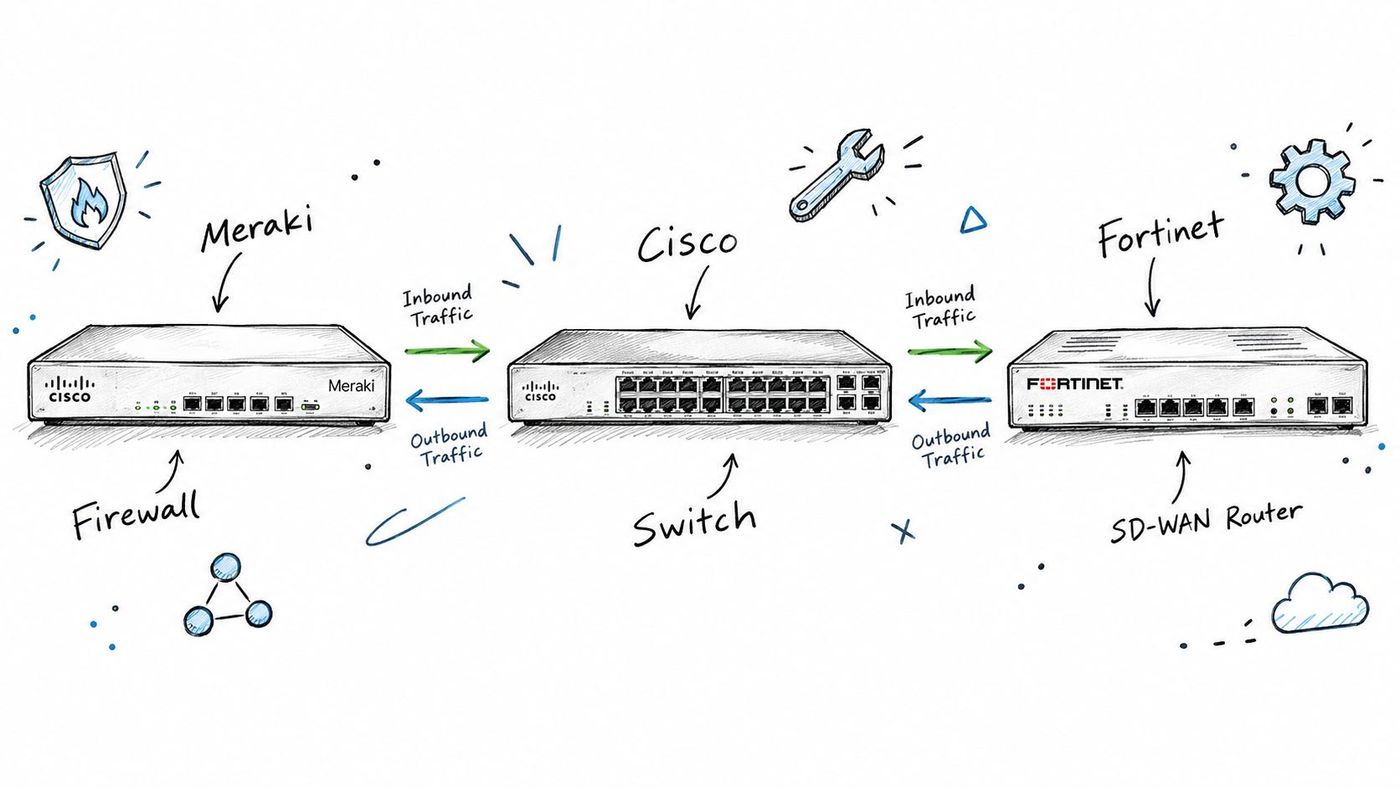
In Meraki, start with VLAN and switch-port design. Place approved phones in a voice VLAN, enable voice-aware handling where supported, and avoid trusting arbitrary DSCP markings from access ports. On the MX, traffic shaping rules should match the applications and users that the business has identified, with WAN rules applied on the correct uplink.
The intent might look like this:
UniFi deployments often combine gateway, switch, and wireless settings in a central interface. Define the voice network explicitly, map SSIDs and switch ports to the correct VLANs, and test whether the gateway preserves or rewrites DSCP values. Wireless airtime remains a separate constraint. A priority rule won't make a crowded radio channel reliable.
If a client needs Cisco-compatible WiFi hardware, validate the roaming, tagging, and marking behaviour as part of the same end-to-end test. Mixing access points and switching platforms can work well, but only when the trust boundary is documented.
Catalyst switches provide granular control over classification, marking, trust, and queue mapping. A typical access-layer design trusts a phone's auxiliary VLAN while treating the attached workstation differently, then applies a policy to ensure the uplink honours the intended DSCP-to-queue map. The exact commands depend on the Catalyst family and software release, so engineers should validate syntax against the deployed platform rather than paste a generic template.
Conceptually, the policy should express:
Firewall-led SD-WAN platforms such as Fortinet and Palo Alto typically classify by application, user, interface, and service policy. That's powerful for encrypted cloud services, but it can also create false confidence. Confirm that the policy is attached to the actual congested egress, inspect queue counters, and review whether a security profile adds processing delay. A managed firewall services approach can help when rule ownership, firmware changes, and evidence collection exceed the internal team's available time.
Use change control: capture the current configuration, define one change, record the expected outcome, test during an agreed window, and retain before-and-after evidence. A policy that can't be rolled back isn't ready for production.
VoIP reveals network weaknesses quickly because users notice broken audio before a dashboard does. Microsoft Teams Phone, SIP trunks, session border controllers, and on-premise PBXs all depend on the same fundamentals: correct endpoint marking, predictable egress, adequate upload capacity, and a path that doesn't discard priority markings.
Microsoft's common QoS guidance uses DSCP 46, EF, for voice and DSCP 34, AF41, for video. The values only help if endpoints mark them, switches trust the right boundary, WAN devices preserve them, and queues map them consistently. Configure the client and device policies, then verify the packet path. Don't assume that selecting a Teams checkbox on a firewall completes the deployment.

Teams Phone users may connect through desk phones, computers, mobile devices, or a browser. A desk phone can apply markings directly, while a computer may depend on operating-system policy and application behaviour. A session border controller adds another trust boundary, especially when it sits between a voice VLAN and a firewall.
ExpressRoute or a managed SD-WAN service can improve path control, but neither removes the need for measurement. A private or managed path may still experience congestion at the branch, firewall, wireless layer, or provider handoff. Consumer broadband can support business VoIP in some environments, but unstable upload or asymmetric service will defeat a polished QoS policy.
Before rollout, test a representative call from each site and connection type. Record whether the audio path is direct or relayed, whether the markings survive each hop, and whether call quality changes when backups or large uploads run. The Microsoft Teams Phone system guide is a useful reference when voice architecture and collaboration design need to be considered together.
In regulated environments, retain the policy version, endpoint configuration, test time, site, call type, observed metrics, and approval record. That audit trail distinguishes a controlled voice service from a collection of screenshots and user complaints.
A QoS setup that nobody measures is just a router setting. Verification should start at the customer-premises modem, test to an off-net server connected at an Internet exchange point in a Canadian Tier 1 city, and run during weekday peak hours from 7:00 p.m. to 11:00 p.m. local time, following the CRTC performance measurement methodology.
Use a baseline before changing queues or markings. The CRTC high-quality thresholds give a practical reference point, no more than 50 ms round-trip latency, 0.25% packet loss, and 5 ms jitter. Keep that methodology reference in your internal measurement record so every probe, dashboard, and incident note points to the same baseline.
An average can hide a bad burst. Record:
Correlate each breach with WAN utilisation, Wi-Fi interference, firewall CPU, queue drops, interface errors, and ISP handoff performance. Measuring only to an internal gateway is a common mistake because it can look clean while congestion exists beyond the LAN. Running tests only off-peak creates the same false reassurance.
A small IT team does not need a full network operations centre to produce usable evidence. A managed monitoring platform can alert on sustained threshold breaches, retain time-series data, and attach an incident note. Teams selecting tools can compare that workflow with a practical network monitoring guide for East Midlands firms, while the network monitoring best practices guide gives broader operational context.
Run the same tests before and after deployment, under comparable conditions. Present the board with the baseline, policy change, observed breaches, application impact, and remaining exceptions. That is more credible than claiming a new queue “feels faster.”
The fastest way to troubleshoot QoS is to follow evidence from the user's symptom to the congested queue. A choppy telehealth call, failed trade confirmation, or stalled imaging upload is not proof that the ISP failed. It may indicate a full upload queue, asymmetric routing, double NAT, a mis-trusted DSCP value, or a security appliance that is dropping packets under inspection load.
More capacity can help, but it rarely fixes reliability by itself. Classification, queue design, monitoring, and provider accountability decide whether capacity reaches the application that needs it.
Queue starvation appears when a strict-priority class consumes too much service and other traffic accumulates behind it. Inspect queue counters and utilisation during a reproduction test. If the voice queue grows continuously or other classes show drops, reduce the scope of strict priority and use reservations for video and business applications.
Asymmetric upload is common in offices that download quickly but struggle when cameras, backups, and file synchronisation send data simultaneously. Test upload independently, then repeat while generating controlled traffic. If interactive sessions degrade only during upstream load, shape the uplink and separate bulk transfers rather than increasing download capacity.
ISP handoff overload requires provider-side evidence. Compare the modem-side probe with firewall interface counters and WAN statistics. A clean LAN, a saturated handoff, and matching peak-hour degradation give the provider a defensible escalation package.
Double NAT and incorrect trust can prevent markings from surviving the path. Trace the packet across the phone or workstation, access switch, firewall, SD-WAN edge, and provider connection. Confirm the DSCP value at each boundary and check that the policy is attached to the interface carrying the actual congestion.
Healthcare and finance add governance requirements to these technical tests. Prioritising voice or video must not starve endpoint detection, backups, audit logs, patch delivery, or security inspection. In a clinic, encrypted clinical traffic may compete with imaging and recovery operations. In finance, a fast user transaction still needs controlled logging and reliable evidence.
The Canadian Centre for Cyber Security's baseline controls are designed for organisations with fewer than 500 employees. They recommend identifying systems and assets in scope, documenting exclusions and their risk, maintaining an incident-response plan for different severities, limiting accounts to necessary functionality, and using administrator accounts only for administrative work (Canadian Centre for Cyber Security baseline controls). QoS change records fit naturally into that governance model.
Healthcare leaders should also connect network changes to their broader healthcare IT compliance responsibilities. PIPEDA, Quebec's Law 25, HIPAA where applicable, and PCI DSS are not interchangeable checklists, and a QoS policy doesn't make an organisation compliant. It does, however, create another controlled change that should record the owner, approval, affected systems, test evidence, rollback path, and review date.
Consider a clinic where Teams video freezes whenever overnight imaging replication begins. Start with the timestamp from the user report. Compare the monitoring probe, firewall WAN utilisation, queue drops, Wi-Fi metrics, and replication job status for that interval. Run a controlled test with replication paused, then repeat with shaping and a defined reservation for interactive video.
If the call improves only when replication stops, the evidence supports a contention problem. If it remains poor, inspect wireless airtime, endpoint CPU, firewall inspection, and the upstream path. If the provider-side test breaches the service objective while internal counters remain healthy, escalate with timestamps and measurements rather than a general complaint.
A 90-day rollout keeps the work manageable:
Cloud adoption makes this ownership more important. Statistics Canada reported that 48% of Canadian businesses used cloud computing in 2023, with usage reaching 81% in the information and cultural industries (Statistics Canada cloud computing data). The more business processes move into cloud platforms, the less useful it becomes to judge service quality from a single office speed test.
A managed IT partner or vCIO can keep the policy honest by reviewing thresholds, provider performance, application changes, and security dependencies over time. That matters because QoS decays when a new access point, firewall rule, cloud service, backup platform, or branch circuit arrives without updating the original design. The objective isn't a perfect router configuration. It's a repeatable operating practice that shows whether employees, patients, clients, and production teams receive the service the business promised.
CloudOrbis Inc. helps Canadian SMBs design, deploy, and monitor quality of service alongside managed IT, cybersecurity, cloud, backup, and business VoIP initiatives. If your clinics, branches, or offices need measurable reliability rather than another unverified router change, visit CloudOrbis Inc. to discuss an assessment and practical rollout plan.
Book a 30-minute call with a senior engineer. No sales script, just straight answers about your environment.


