Solutions for Network Security
Solutions for network security. Discover proven network security solutions for SMBs in Canada. Compare firewalls, IDS/IPS, segmentation, VPNs, and managed

Solutions for network security. Discover proven network security solutions for SMBs in Canada. Compare firewalls, IDS/IPS, segmentation, VPNs, and managed
A phishing email can remain hidden in your environment while your firewall reports green status, your endpoint dashboard shows no incidents, and your team carries on with payroll, production, and customer deliveries. By the time someone notices unusual file access or a supplier questions an invoice, the security stack may still be operating exactly as configured. The problem is that “operating” and “protecting” aren't the same thing.
Canadian businesses face a practical network security problem, not an abstract technology challenge. In 2024, police-reported cybercrime reached 225.1 incidents per 100,000 Canadians, more than double the 2018 rate of 91.9. Fraud accounted for 46,301 incidents, almost half of all reported cybercrime cases, according to Statistics Canada's cybersecurity overview. Your business doesn't need every security product on the market. It needs the right controls, clear ownership, and regular proof that those controls work.
At 8:12 on a Monday morning, the CFO of a 120-person manufacturing company outside Hamilton opened an email that appeared to come from a familiar supplier, Northstar Industrial Components. The message contained a revised invoice and a request to confirm updated payment details. Someone in accounts payable had opened a similar message three weeks earlier.
The email didn't trigger an obvious alarm. The employee entered credentials into a convincing sign-in page, and the attacker used those credentials to access a cloud sync tool connected to the finance team's shared folders. Invoice data began moving to a staging server in Eastern Europe. The activity blended into ordinary file synchronization, so the firewall saw permitted outbound traffic and the endpoint software recorded no malware incident.
By Monday morning, the supplier called to ask why several invoices contained altered banking instructions. The finance manager checked the cloud audit trail and found unusual downloads. The IT lead reviewed firewall logs and endpoint alerts, then called the firewall vendor. The vendor pointed to the cloud platform. The cloud provider pointed to the stolen credentials. The security consultant asked whether the company had tested an alert for suspicious cloud exfiltration.
The IT lead had to admit they never had.
The next conversation was more uncomfortable. Did the incident involve personal information? Did the company need to assess notification obligations under PIPEDA? Which records had left the environment, and could the firm prove that no employee or customer data was included? The company had bought security tools, renewed licences, and received regular dashboard reports. It still lacked the visibility and tested response process needed to answer basic questions.

This is a hypothetical scenario, but the operational pattern is common: a legitimate account, an allowed service, incomplete logging, and nobody assigned to validate the detection. Canadian businesses reported spending about $1.2 billion on cyber incident recovery in 2023, double the roughly $600 million reported in 2021, according to Statistics Canada's national data. The point isn't that every incident follows this exact path. The point is that a stack can be intact while the business remains blind.
This guide focuses on solutions for network security that include a verification step. For every defensive layer, you need to know how you'll confirm it detects, blocks, records, and supports recovery during an actual incident.
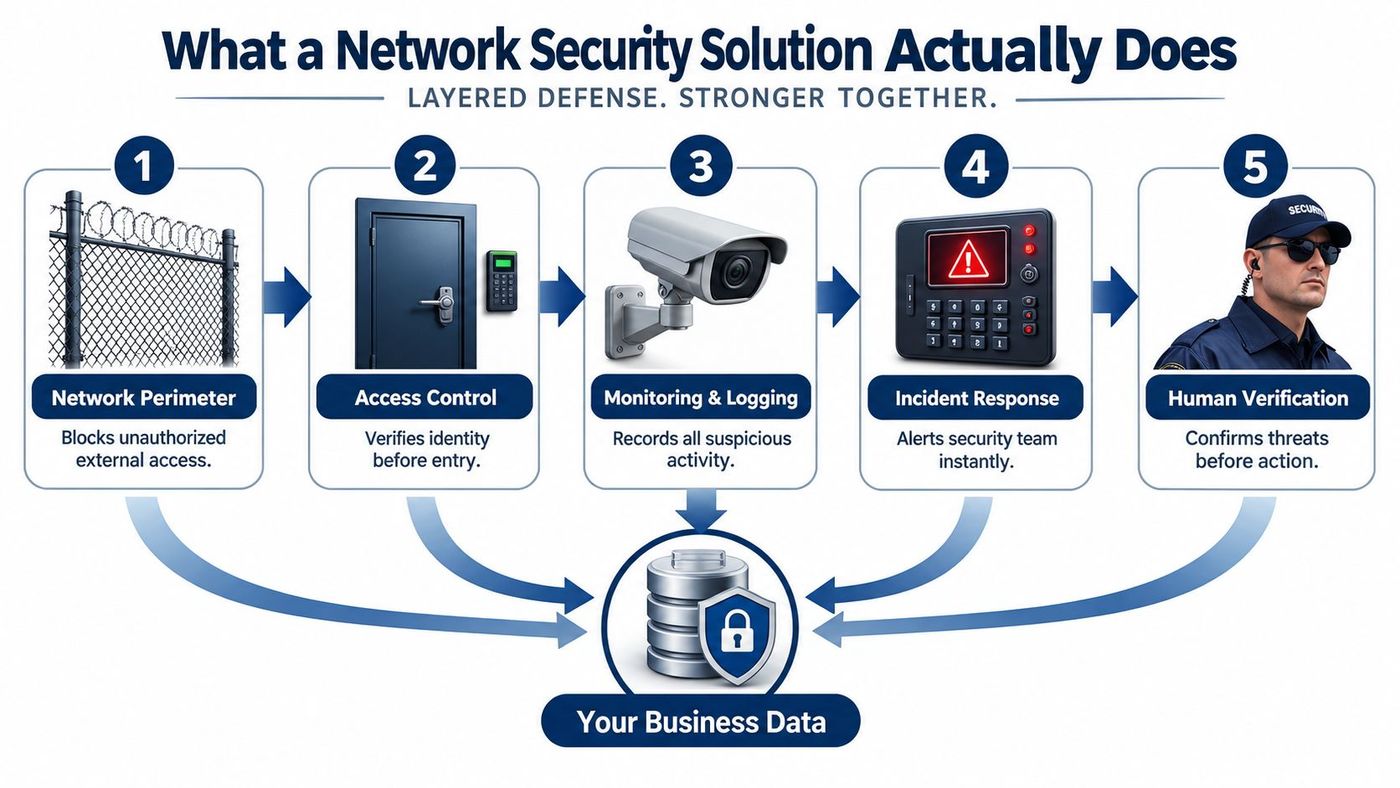
Think about a commercial building. A fence discourages casual entry. Locked doors restrict access. Cameras record movement. An alarm service receives signals. A trained guard checks whether an alert represents a real threat before someone takes action.
A network security solution applies the same principle to business systems. It combines technology, processes, and people to reduce the likelihood or impact of unauthorized activity across networks, cloud services, devices, and connected applications. No single product sees every attack path.
The perimeter includes firewalls, secure internet gateways, and filtering services. These controls block unwanted connections and restrict traffic according to policy. Your verification step is a controlled test of blocked traffic, rule review, and confirmation that security staff receive meaningful alerts rather than a silent dashboard update.
Access control includes multifactor authentication, privileged access management, and network segmentation. These measures limit who can enter, what they can reach, and which actions they can perform. Test them by reviewing dormant accounts, attempting access with a controlled test identity, and confirming that an employee who changes roles loses access promptly.
Monitoring and logging provide the cameras. Intrusion detection systems, endpoint telemetry, cloud audit logs, and identity records create the evidence needed to reconstruct activity. A useful starting point is CloudOrbis's guide to intrusion detection systems, particularly when deciding which events deserve immediate review.
Incident response turns evidence into action. Your team needs a documented process for containment, escalation, communications, legal review, and recovery. Run a tabletop exercise that starts with a realistic alert and makes participants identify who owns each decision.
Human verification remains essential. Automated systems can flag suspicious behaviour, but someone must determine whether the event is malicious, contain it, and communicate the consequences. For practical guidance on protecting conversations and business information, the SnapDial secure communication guide offers useful context alongside technical network controls.
Practical rule: If nobody can explain what happens after an alert fires, the control isn't complete.
Preventive controls, such as firewalls, segmentation, MFA, and endpoint protection, try to stop unauthorized activity. Detective controls, including intrusion detection, SIEM platforms, and log review, help you identify activity that prevention missed. A resilient programme uses both, then tests the handoff between them.
Most mid-sized businesses need several categories, but they don't need to buy each product independently. The right mix depends on data, remote access, cloud dependence, compliance obligations, internal skills, and tolerance for downtime.
| Category | Primary Threat Addressed | Typical SMB Deployment | Common Failure Mode |
|---|---|---|---|
| Firewalls and next-generation firewalls | Unauthorised network access and harmful traffic | Perimeter appliance or cloud-managed firewall | Rules block basic traffic but encrypted flows, exceptions, and rule changes go unreviewed |
| Intrusion detection and prevention | Suspicious network behaviour and known attack patterns | Network sensors, cloud sensors, or integrated security platform | Alerts accumulate without triage or tuning |
| Network segmentation | Lateral movement after compromise | Separate networks for users, servers, guests, production, and sensitive systems | Flat networks remain in place because segmentation disrupts convenience |
| VPN and Zero Trust Network Access | Unsafe remote access and excessive trust | VPN for defined use cases, ZTNA for application-level access | Remote users receive broad network access after one successful login |
| Endpoint protection platforms | Malware, credential theft, and device compromise | Managed agents across workstations, servers, and mobile devices | Agents are disabled, outdated, excluded from scans, or poorly monitored |
| SIEM with managed detection and response | Missed correlations and delayed response | Cloud SIEM paired with an internal team or MDR provider | Dashboards exist, but no one owns investigation or after-hours response |
Firewalls are still foundational, especially for offices, plants, and environments with operational technology. A next-generation firewall can apply application awareness and threat inspection, but encrypted traffic, poorly maintained exceptions, and vendor remote access can create blind spots. Verify it with scheduled rule reviews, test traffic, and evidence that the team can distinguish a blocked event from a permitted but suspicious session. A managed firewall model is worth comparing through CloudOrbis's managed firewall services overview.
Intrusion detection and prevention adds a second view. It can identify patterns that a perimeter rule misses, including unusual scanning, command-and-control behaviour, or movement between internal systems. The failure is usually operational rather than technical. If nobody tunes noisy signatures or investigates priority alerts, the sensor becomes expensive background noise.
Segmentation limits the damage after an account or device is compromised. A manufacturing business might separate office users, production systems, suppliers, guest Wi-Fi, and backup infrastructure. Segmentation creates administration work and can expose old dependencies, but those discoveries are valuable. Test it by confirming that a test account can reach only the systems required for its role.
VPN remains appropriate for some remote access, but a VPN can place a user inside a broad network once authenticated. Zero Trust Network Access narrows access to specific applications and evaluates identity, device condition, and policy. Neither approach fixes weak identity governance. Review access when people change roles, leave the business, or need temporary supplier connectivity.
Endpoint protection covers the devices that users operate. It should detect suspicious processes, isolate compromised devices, and provide usable investigation data. Test isolation on a controlled device, confirm the alert reaches the responsible person, and check that exclusions have an owner and an expiry date.
SIEM and managed detection and response connect the evidence. SIEM collects and correlates logs, while MDR adds analysts and response procedures. Choose based on capacity, not fashion. A business with no one available to investigate alerts outside office hours should not pretend that an unattended SIEM dashboard provides equivalent coverage.
Compliance doesn't tell you to buy a particular brand of firewall. It does require you to understand the sensitivity of your information, restrict access, protect it appropriately, and demonstrate that your safeguards operate as intended.
PIPEDA's reasonable safeguards principle makes risk-based security a management responsibility. A professional services firm handling client contracts, payroll information, and identity documents needs strong identity controls, encryption, access reviews, retention rules, and incident records. A retailer handling payment cards has a different exposure, with payment environment segmentation, encryption, access restrictions, and evidence of testing taking priority.
Ontario healthcare organizations must consider PHIPA, while businesses operating in British Columbia may need to account for PIPA. The exact obligations depend on the organization, information, activities, and jurisdiction. A useful overview of the broader context appears in CloudOrbis's guide to Canadian data privacy laws.
| Framework | Applies To | Mandatory Solutions | Verification Required |
|---|---|---|---|
| PIPEDA | Organizations handling personal information in covered commercial activities | Access control, encryption, logging, incident response, retention governance | Access reviews, incident exercises, log checks, documented safeguards |
| PHIPA | Ontario custodians and organizations handling personal health information | MFA, segmentation, least-privilege access, encryption, audit trails | User access testing, audit-log review, breach response exercise |
| BC PIPA | Covered private-sector organizations in British Columbia | Identity controls, secure storage, monitoring, privacy governance | Policy review, access validation, incident documentation |
| PCI DSS 4.0 | Businesses that store, process, or transmit cardholder data | Segmentation, encryption, MFA, vulnerability management, monitoring | Control testing, access reviews, vulnerability validation, evidence retention |
| CyberSecure Canada | Canadian organizations seeking the federal cybersecurity certification | Baseline safeguards, documented practices, training, response planning | Readiness assessment, control evidence, recurring review |
A 40-person accounting firm may prioritise secure collaboration, identity governance, endpoint control, and protected client records. A 75-person retailer may need stronger payment network separation, point-of-sale monitoring, vendor access controls, and rapid containment. Employee count alone doesn't determine the solution. Data type, business model, connectivity, and potential harm do.
The Canadian Centre for Cyber Security's baseline controls for small and medium organizations use an 80/20 rule, aiming to deliver about 80% of the benefit from 20% of the effort for organizations with fewer than 500 employees in Canada. That makes the framework a practical starting point, not a substitute for sector-specific analysis.
Ask three questions before approving a security purchase:
Your answers determine which controls are essential. They also determine what evidence you need to retain when a customer, auditor, insurer, or regulator asks how the control was validated.
Buying a security product isn't the same as preparing the business. In a 2025 survey of 308 Canadian SMB decision-makers, 47% said their business was prepared for a cyberattack or data breach, 48% had implemented any cyber defence, and only 34% had tested the strength of their security measures, according to the Insurance Bureau of Canada survey summary. Those figures point to a readiness gap, not a product shortage.
The same Canadian survey reported that 42% of organizations experienced a breach of customer or employee data in the previous 12 months, while 24% experienced ransomware and 74% of ransomware victims paid the ransom. Those numbers don't prove that a particular tool failed. They do show why a procurement checklist can't stand in for incident preparation.
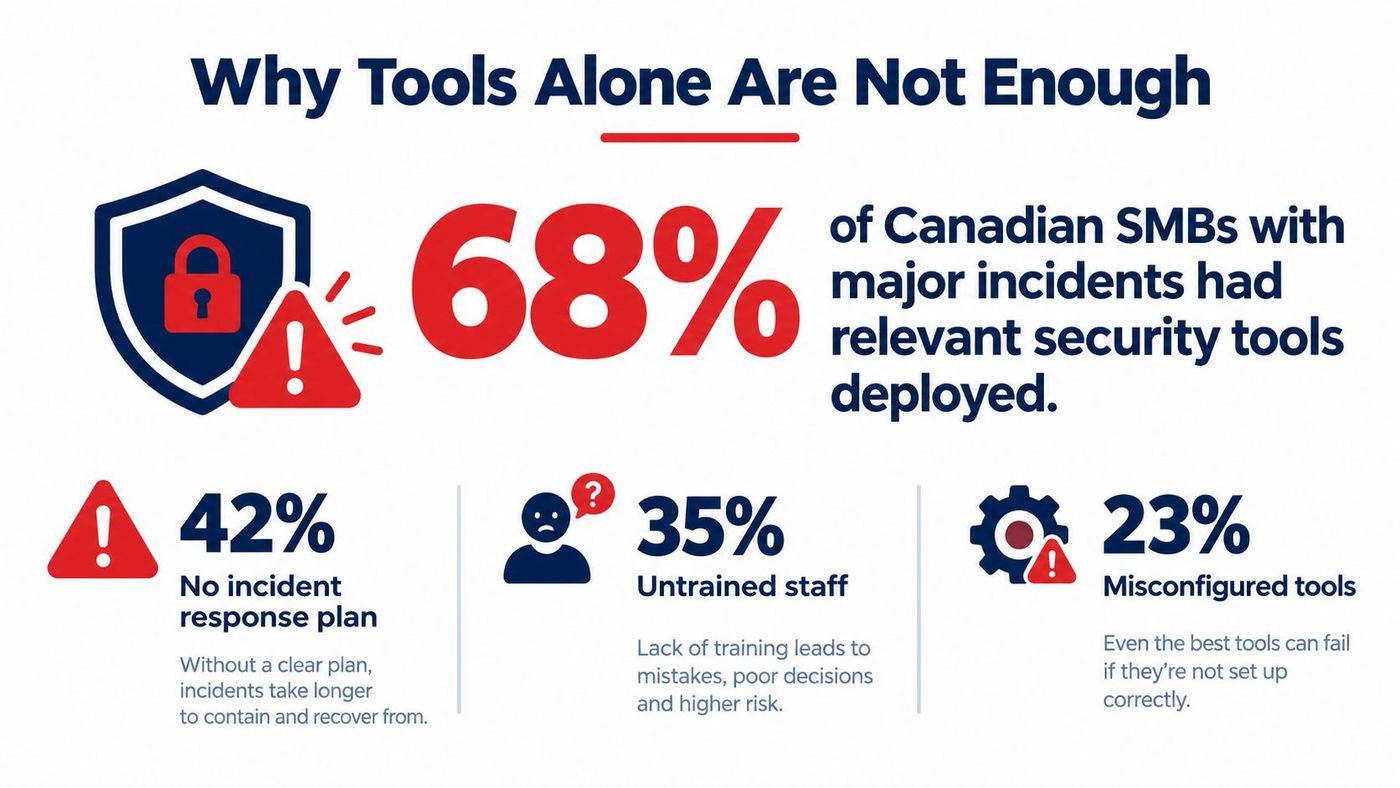
A firewall may still pass traffic while its rules reflect an old network. Administrators add exceptions for suppliers, remote workers, cloud applications, and temporary projects, then never remove them. Review the rule base on a defined schedule, identify business owners for exceptions, and test whether sensitive services remain reachable from untrusted networks.
An IDS or SIEM may generate a steady flow of alerts that nobody triages. Analysts need severity thresholds, escalation paths, and enough context to make decisions. If a provider says it offers monitoring, ask who investigates alerts, during which hours, and what the response record looks like.
Endpoint agents can also lose effectiveness when users disable them, devices fall outside management, or exclusions remain in place after a troubleshooting exercise. Security teams should receive tamper alerts, investigate unmanaged devices, and verify that isolation and remediation workflows work on a controlled endpoint.
Canadian businesses also face a governance gap. The federal cyber guide for small and medium businesses reported that only 26% of Canadian businesses had written cybersecurity policies in 2021, an increase of at least four percentage points from 2019, according to Get Cyber Safe's small business guide. A written policy matters because it assigns decisions before an incident creates pressure.
A smaller stack with clear ownership and tested response will outperform a larger stack that nobody watches.
Use managed detection and response when internal staff can't provide continuous investigation. Add quarterly configuration audits, tabletop exercises, breach simulations, recovery drills, and occasional purple-team testing. Employee behaviour also needs attention, so pair technical controls with security awareness training that teaches people how to report suspicious messages and protect credentials.
Verification should produce evidence. Keep the test date, scenario, result, owner, corrective action, and retest outcome. That record helps management decide what to fund and gives your team a factual answer when someone asks whether the control works.
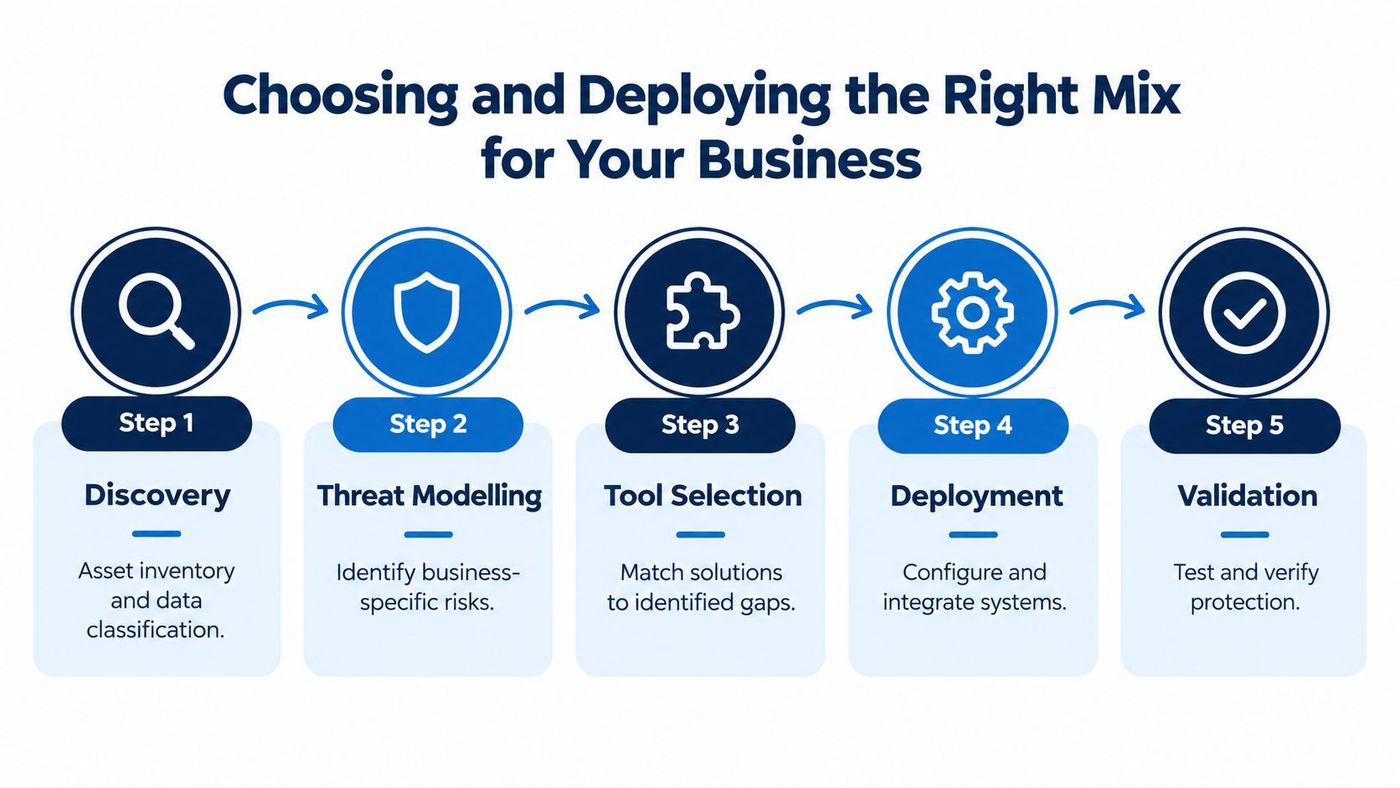
Start with discovery, not a vendor presentation. Build an inventory of devices, cloud services, identities, suppliers, production systems, backups, and sensitive data stores. Then classify the information according to business impact and identify the paths an attacker could use to reach it.
Use a simple internal score based on likelihood, business impact, and compliance weight. You don't need a complex risk platform. You need a repeatable method that explains why one control comes before another.
Map the five highest risks to solution categories. For example, compromised supplier credentials may lead to MFA, ZTNA, privileged access controls, and cloud logging. Ransomware affecting shared production files may lead to endpoint isolation, segmentation, protected backups, and recovery testing.
A practical deployment sequence looks like this:
Vendor selection deserves the same discipline. Ask where logs and customer data reside, whether the service supports Canadian data residency requirements, who provides after-hours coverage, and how the platform integrates with Microsoft 365, Microsoft Entra, Google Workspace, or your existing endpoint tools. Request transparent pricing that separates implementation, licences, monitoring, response, and remediation.
Don't accept “fully managed” as a sufficient answer. Ask to see a sample monthly report, an escalation procedure, a recent anonymised incident timeline, and the process for testing a detection. If the provider can't explain what happens after an alert, keep looking.
Insurance is another part of the risk conversation, but it shouldn't replace prevention. Review coverage conditions, exclusions, notification requirements, and required safeguards with a qualified adviser. Guidance on evaluating cyber coverage is available through cyber insurance advice from ABS Insurance Brokers from ABS Insurance Brokers Pty Ltd.
Most organizations under 200 employees face a difficult choice. They can hire an internal security lead, maintain separate relationships with firewall, endpoint, backup, compliance, and monitoring vendors, and build after-hours coverage themselves. Or they can use a managed services model in which one accountable provider coordinates detection, response, maintenance, and verification.
The in-house route can work when the business has the budget, specialist skills, and operational scale to support it. It becomes fragile when one person owns security alongside infrastructure, user support, vendor management, and compliance. Holidays, turnover, competing priorities, and overnight incidents expose the gap quickly.
A managed partner should meet three tests:
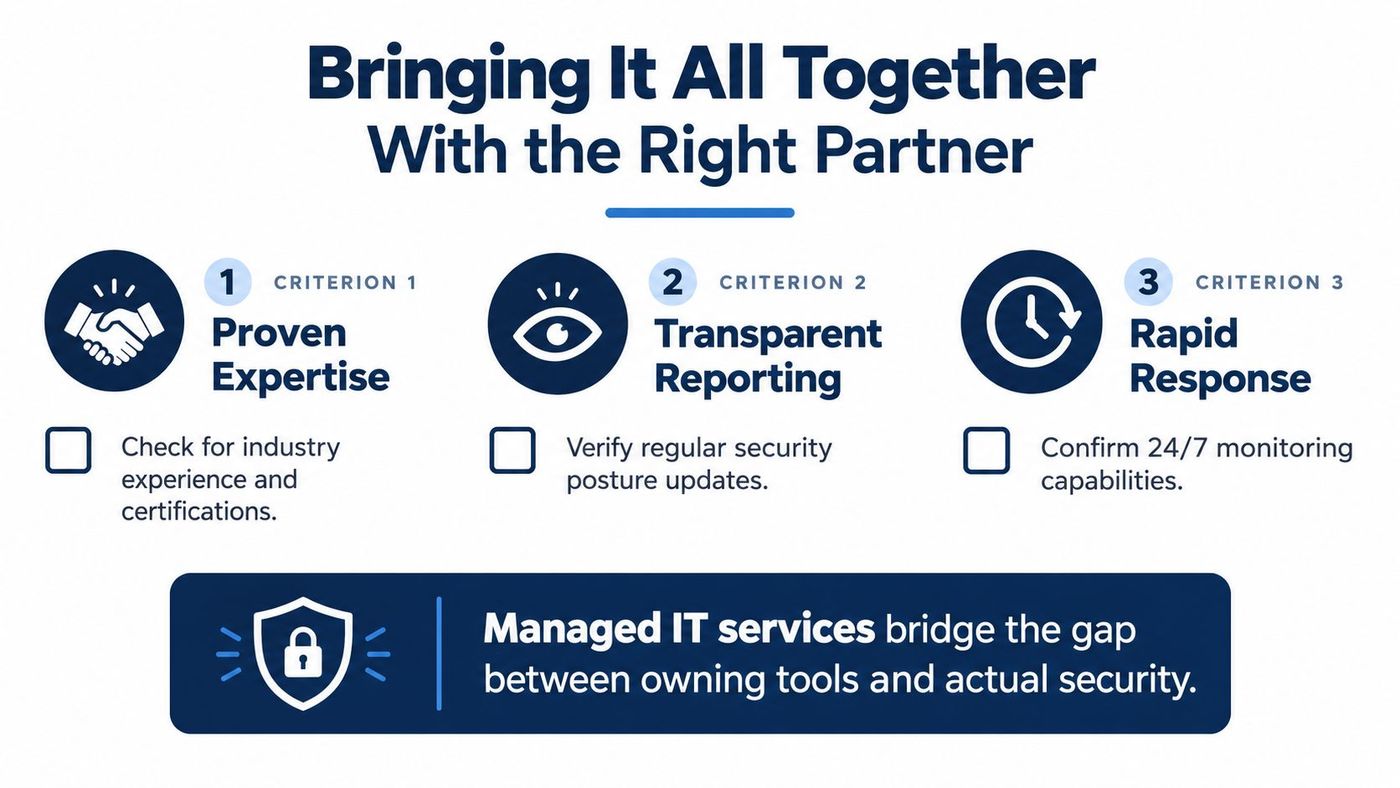
CloudOrbis Inc. provides managed IT support, network and server management, managed firewall services, endpoint protection, threat detection, vulnerability assessments, security awareness training, backup and disaster recovery, and compliance support for Canadian small and mid-sized businesses. Its 24/7 Canada-based helpdesk and proactive monitoring model are designed to connect day-to-day IT operations with security oversight. You can review the broader cyber security service offering when comparing managed providers.
The right partner won't just add another dashboard. It will map current gaps to the six solution categories, identify what deserves attention first, and establish a repeatable verification cycle. That changes network security from a collection of licences into an operating capability.
CloudOrbis Inc. can assess your current network security controls, identify gaps across firewalls, endpoints, access, monitoring, and response, and build a practical 30, 60, and 90-day remediation plan. Visit CloudOrbis Inc. to request an assessment and discuss fixed monthly support for a more resilient Canadian IT environment.
Book a 30-minute call with a senior engineer. No sales script, just straight answers about your environment.


