Threat Detection Methods: A Practical Guide for SMBs
Learn how threat detection methods work, from signatures and behaviour analysis to EDR, NDR, SIEM and threat hunting, plus how SMBs should choose.

Learn how threat detection methods work, from signatures and behaviour analysis to EDR, NDR, SIEM and threat hunting, plus how SMBs should choose.
Most owners I sit with have already paid for the alarms. Antivirus is on, the firewall is renewed, and the invoice looks complete. The harder question is what happens at 2 a.m. if something goes wrong. Who notices, and how fast can someone decide what to do?
Threat detection methods are the ways a business spots trouble early enough to limit downtime. Each method watches a different place. Each one is only as useful as the person who can act on the alert. The walkthrough below takes the options one layer at a time, and it is direct about what each tool cannot see.
In 2017, 94% of Canadian businesses reported spending at least some money to prevent or detect cybersecurity incidents, with average spending of about $78,000 per business. Even with that spending, 21% said incidents still affected their operations, according to Statistics Canada's review of business cybersecurity. Paying for protection is not the same as seeing an attack in time.
A smoke alarm nobody hears is just ceiling hardware. Detection works the same way. It means noticing a relevant threat early enough to limit downtime, fraud, or unauthorized access, and you measure it by how fast the right event reaches someone who can act, not by how many products sit on a renewal spreadsheet.

A control that cannot produce time-stamped evidence also cannot support an investigation, a police report, or a recovery decision.
Judge every method by two questions: what can it see, and how quickly does what it sees become a decision? A suspicious login flagged at noon and reviewed at noon is a detection win. The same login reviewed next quarter is a footnote. A firm of 50 to 250 people rarely has analysts on a night shift, so an alert that fires at 2 a.m. only matters if someone is on the other end of it. The practical toolkit is six methods: signature checks, behaviour and machine learning, endpoint detection and response, network detection and response, security information and event management, and threat hunting. Each watches a different place, each misses something, and the right blend depends less on the product list than on the staff available to respond.
| Method | What It Watches | Strongest At | Main Limit | Typical SMB Fit |
|---|---|---|---|---|
| Signature-based detection | Files, code and traffic matched against known threat patterns | Known malware, fast and inexpensive | Misses new or lightly altered threats | Baseline layer, always on |
| Behaviour and machine learning | Actions compared with a learned normal baseline | Novel attacks and unusual activity | False positives; needs tuning and review | Built into most modern EDR products |
| EDR (endpoint detection and response) | Activity on laptops, servers and other endpoints | Ransomware, credential theft and isolating a device | Sees only devices where the agent is installed | Core layer for almost every SMB |
| NDR (network detection and response) | Network traffic and movement between devices | Devices with no agent, lateral movement | Limited view of encrypted content | Useful where many unmanaged devices exist |
| SIEM (security information and event management) | Logs from identity, email, firewall, VPN and cloud sources | Correlating weak signals across sources; compliance evidence | Costly to tune; needs skilled staff or a managed service | Mid-sized firms with compliance duties |
| Threat hunting | Analysts searching logs for activity that has not triggered an alert | Stealthy attackers that evade alerts | Depends on analyst skill and log coverage | Usually delivered as a managed service |
No row covers the whole building. Signatures look at files, code and known traffic patterns. Behaviour tools compare actions with a baseline. EDR sits on devices. NDR watches traffic between them. A SIEM reads logs. Hunting looks for the attacker who never tripped an alert. They also overlap in real products. Many EDR tools now include behavioural analytics, and many managed SIEM services include a hunting retainer. Treat the table as a coverage map, not a ranking. A cheap signature engine can be the right first layer if someone still reviews what the later layers cannot see.
The next layers start with the two foundations, then the three platforms, then hunting, then how to choose a mix your staff can realistically run. If you want the older network-sensor idea beside these newer platforms, an intrusion detection systems primer is a useful companion, not a substitute for the map above.
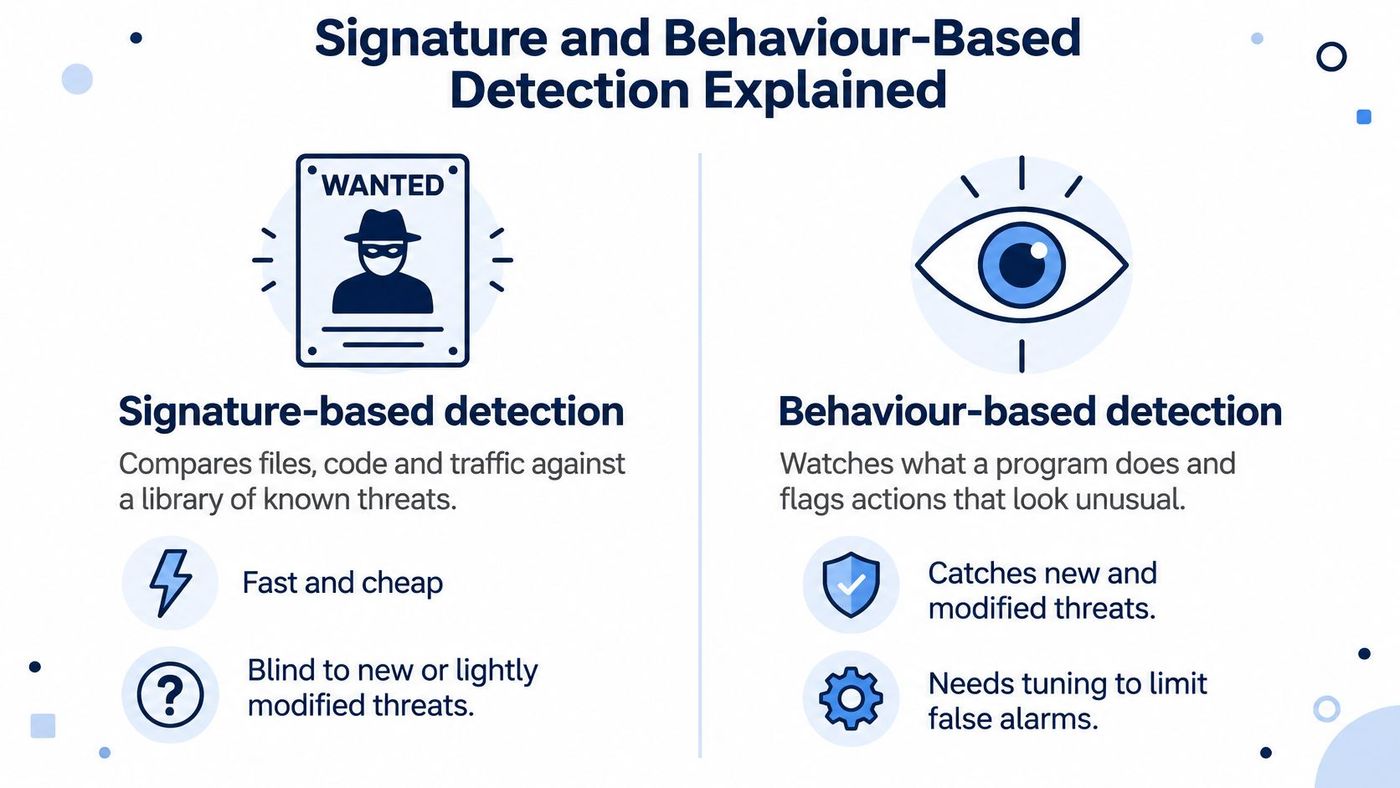
Signature-based detection works like a wanted poster. The tool compares files, code and traffic with a library of known threats. A match fires fast, and the check is inexpensive to leave on all day. Commodity malware and old ransomware strains still get caught this way because they reuse patterns.
Change a small detail and the poster no longer matches. A lightly altered file, a new phishing kit, or malware that rewrites itself walks past a signature that has not been updated. That blindness is the method's main limit. It filters obvious junk so people can spend attention elsewhere. It cannot tell you that a brand-new attack is underway.
Behaviour-based detection is closer to a shop guard who notices someone trying every door, even if that person has never appeared on a poster. The tool watches what a program or account does, then flags actions that look unusual against a learned normal baseline.
Machine learning is how that baseline gets built at volume. Models learn typical logins, processes and data transfers, then flag deviations. Public Safety Canada describes public-safety uses of AI for large volumes of unstructured data, pattern recognition and anomalous activity, and the Canadian Centre for Cyber Security points to automated malware detection, links across attack vectors and predictive intelligence in its work on emerging technology and national security. For a business, that is an augmentation layer on high-volume telemetry, not a replacement for analyst judgment.
A practical split keeps both styles. Supervised rules catch known indicators. Unsupervised or semi-supervised models catch behavioural deviations: abnormal login geography, odd admin sequences, rare parent-child process chains, or transfer volumes that do not match a user's baseline. Correlation across independent signals matters because a novel attack may have no signature at all.
Three everyday cases show the difference:
Models still need governance. Keep features you can explain, set a human escalation threshold, and measure precision and false-positive rates by alert category. Test for drift after staffing changes, new cloud workloads, or seasonal peaks such as tax season or a plant shutdown.
A model that nobody retunes after a cloud migration will keep alerting on last year's normal.
Signatures win on speed and on threats you already know. Behaviour analysis wins on novelty. Both create false positives, and both need tuning plus a written rule for who gets the call.
Think of the office as a small building, not a single lock on the front door.
EDR places a sensor on each laptop and server, like a camera in every room. It records process activity and can isolate a device when ransomware or credential theft shows up. It cannot see a machine where the agent was never installed, or was removed.
NDR watches traffic moving between devices, like cameras in the hallways. It is how you notice printers, cameras and other equipment that cannot run an agent, and how you see one compromised PC reaching for another. Encrypted content stays mostly opaque. You may see that a connection is odd without seeing the payload.
A SIEM is the control room. It collects logs from identity services, Microsoft 365, firewalls, VPNs and cloud platforms, lines up timestamps, and ties events to the same user or device. Weak signals become a story: an odd sign-in, a privilege change, a burst of file access. Cost rises with data volume, and someone has to tune the rules. Without that person, or a managed service, the control room fills with noise.
Canada's federal defenders use the same layered idea. From April 1, 2023, to March 31, 2024, Communications Security Establishment Canada reported that network-based sensors blocked about 2.4 trillion suspicious events, and the architecture still combines endpoint, cloud and automated analysis rather than one control, as set out in the federal cyber-defence audit material. A smaller firm cannot copy that scale. It can copy the principle: do not ask a firewall or antivirus product to see every floor.
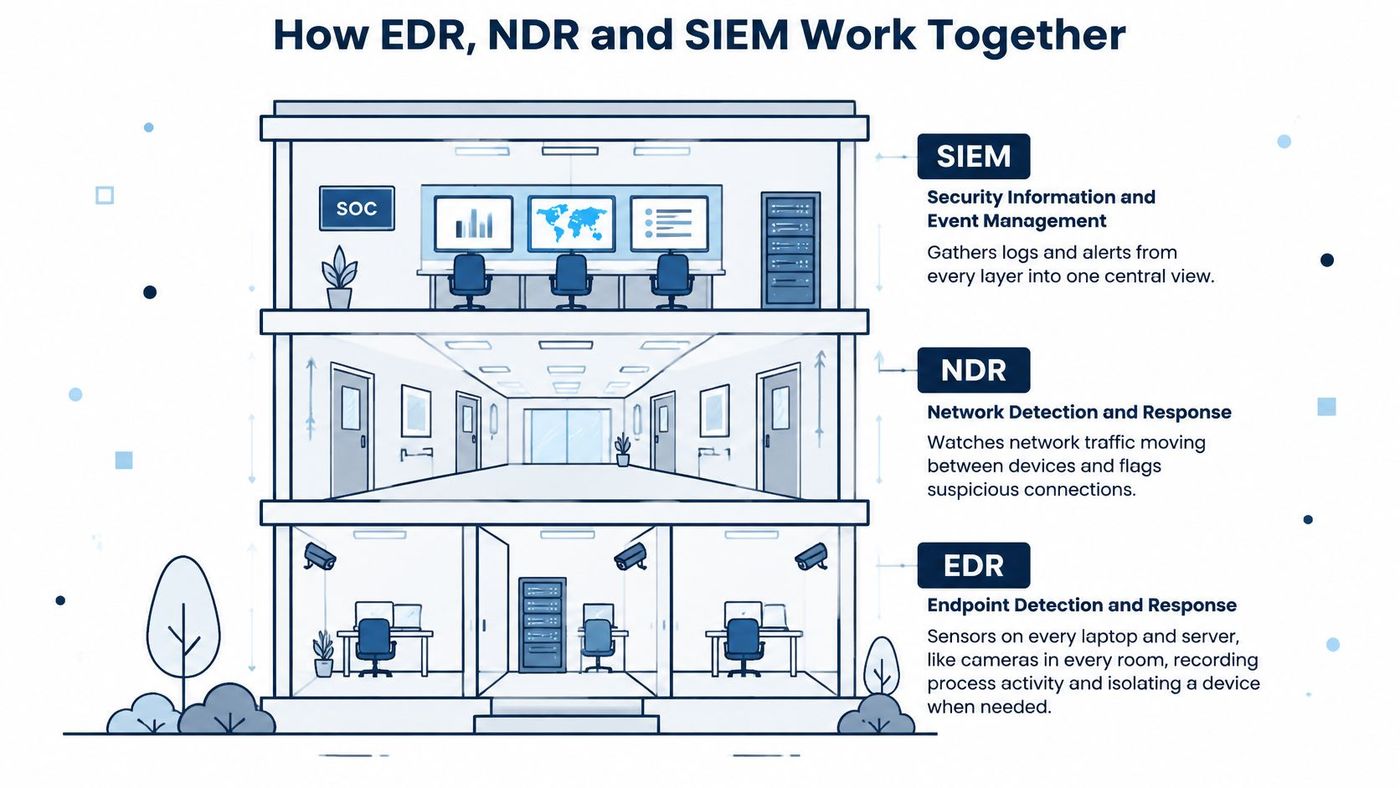
Walk one attack through the building. A stolen password signs in from abroad. The SIEM flags the identity log. A new process starts on the user's laptop, and EDR flags it. The same account then opens many file shares, and NDR sees traffic that does not match that person's afternoon. None of those signals is proof on its own. Together they justify a decision: revoke tokens and isolate the device.
That decision still needs a person. If nobody is assigned after hours, the three layers record a breach you will read about in the morning. The trade-off between an in-house queue and a monitored service is the point of an EDR and MDR comparison. Buy the layer only if someone, on your team or a provider's, can act when the camera sees something.
Alerts react to something that already tripped a rule. Threat hunting asks a question before the alarm fires. Picture a detective who notices a back window was left open and checks every room, even though nobody has reported a theft.
A monthly loop is enough for most small and mid-sized firms:
A skilled in-house analyst can run this. So can a managed provider that includes hunting in the service. Either way, findings should flow back into alert rules, or you pay for the same search every month.
Hunting fails without warning when logs are missing or the analyst does not know the business. An unmonitored mailbox, or a clinic system that never sends logs, produces a clean report that is really an empty room. Schedule the hunt. Do not treat a quiet month as proof that nothing is there.
Five questions decide the mix better than a feature checklist.
Under the federal Personal Information Protection and Electronic Documents Act, you report a breach of security safeguards to the Privacy Commissioner, and you notify affected individuals, when it is reasonable to believe there is a real risk of significant harm. The Office of the Privacy Commissioner's breach guidance ties that test to sensitivity and the chance of misuse. The report is due as soon as feasible, even if the cause is not yet known, which the PIPEDA breach-reporting form states directly. Detection has to keep time-stamped evidence from the first hour, not after a long post-mortem.
| Business Situation | Starting Point | Add Later | Why |
|---|---|---|---|
| Under 50 staff, no security team | Managed EDR with 24/7 monitoring | Behaviour analytics tuned by the provider | Alerts need someone to act on them at any hour |
| Healthcare, legal or finance | EDR and SIEM with log retention | Threat hunting and documented breach assessment | Reporting duties and sensitive records raise the cost of a missed event |
| Clinics, plants or sites with many unmanaged devices | EDR plus NDR | SIEM for cross-site correlation | Devices without agents stay invisible to endpoint tools |
A firm of 50 to 250 people that lives in Microsoft 365 often sits between the first and second rows: EDR plus identity and mailbox logs first, and a managed SIEM when budget and retention duties justify the control room.
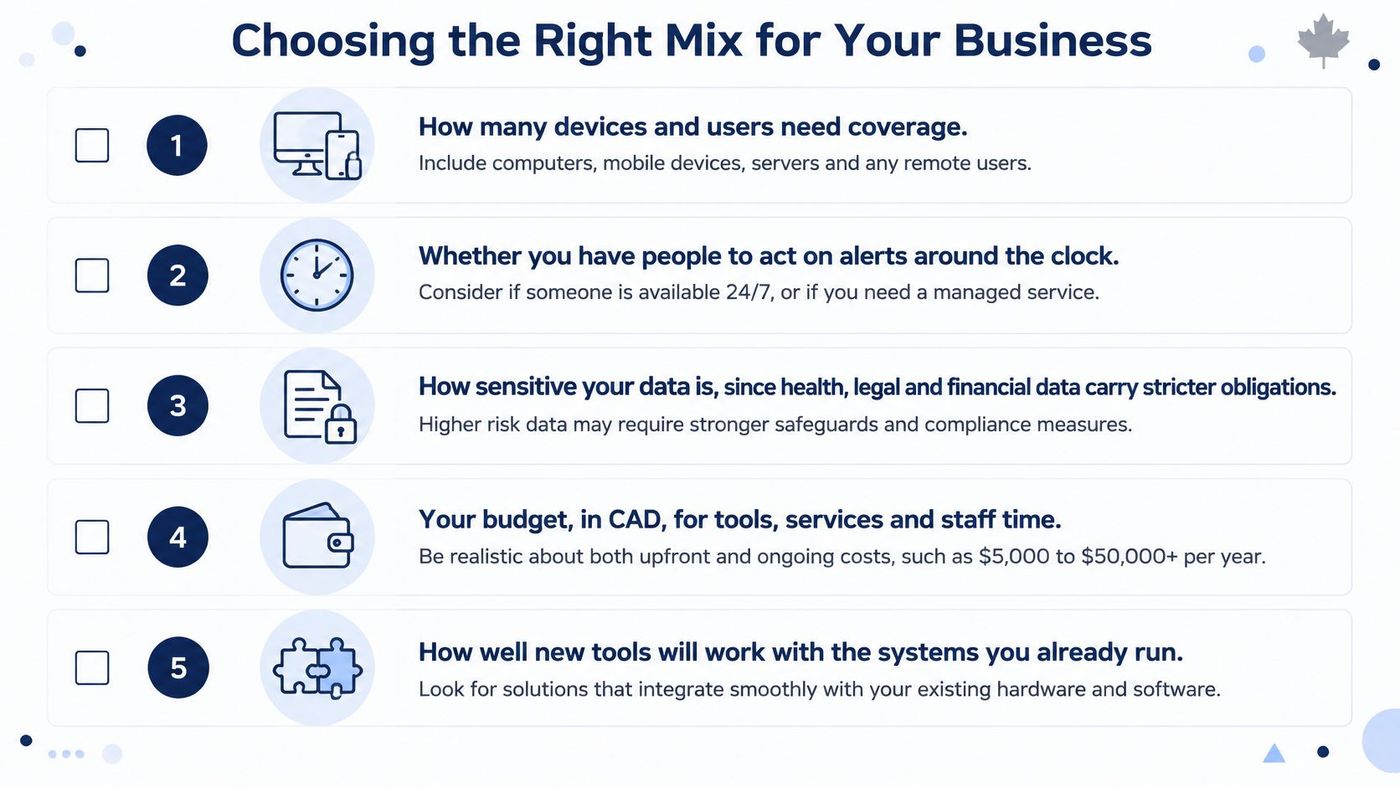
Ask the same things of every proposal, including one you already pay for.
If the answer to “who isolates the laptop at 2 a.m.” is “we'll email you,” you have visibility without a decision.
A business can own six security products and still miss the break-in, the same way a building can mount cameras that nobody watches. The Statistics Canada results cited earlier put the share of Canadian businesses affected by a cybersecurity incident in 2023 at 16%. Tool counts say nothing about that number, because coverage is narrower than ownership: a sensor that can see the event, and a person with the hours to act on what it reports.

| Metric | What It Tells You | How to Calculate It |
|---|---|---|
| Time to detect | How quickly a real threat is noticed | Average hours from first malicious event to first alert |
| Time to contain | How quickly the threat is isolated | Average hours from alert to isolated device or disabled account |
| False-positive rate | How much analyst time is wasted | Benign alerts divided by total alerts, per alert category |
| Coverage of critical assets | Whether key systems are visible at all | Critical systems with active logs or agents divided by total critical systems |
| Alerts investigated | Whether alerts are actually reviewed | Alerts with a documented outcome divided by total alerts |
Pull these from the alerts and tickets you already have. None of the five needs new software, only a spreadsheet, a quiet hour, and honest counting. Run a 30-day baseline before changing tools, so a new product is not credited for a quiet month you never measured. Set targets per system rather than per company: a clinic cares most about anomalous access to patient records, while a manufacturer cares most about odd traffic on the plant floor. One blended target hides the system that would hurt the most.
Read the last row as a staffing question. Every metric assumes a human reviews the output, so a dashboard nobody opens scores the same as no dashboard.
A security audit maps which of your critical systems send logs and where the blind spots sit, turning the table above from a wish into a measurement. List the five systems a breach would hurt most, confirm each one feeds a tool that can see it, and measure again after any change you make.
Spending does not prove you can see a threat. The six methods each watch a different part of the environment, and the right mix depends on device count, who is on call, how sensitive the data is, and whether you can report a breach on time. A plan you cannot test is a brochure.
A gap in any step makes detection look stronger on paper than it performs on a Tuesday night. Teams that already map work to the NIST Cybersecurity Framework 2.0 can drop these four checks under Detect and Respond instead of starting a second program. Run them against your current provider before you add another licence.
CloudOrbis Inc. is a Canada-based managed IT provider with a 24/7 helpdesk that monitors endpoints, investigates alerts and helps contain incidents for small and mid-sized firms. If your detection stack raises alarms nobody can act on, a coverage review will show which systems are actually visible and who answers after hours. Visit CloudOrbis Inc. to book that review and compare it with the checklist you already use.
Book a 30-minute call with a senior engineer. No sales script, just straight answers about your environment.


