Why Managed Security Services for Canadian SMBs
Discover why managed security services are vital for Canadian SMBs facing talent shortages and rising ransomware threats. Learn the ROI and core benefits.

Discover why managed security services are vital for Canadian SMBs facing talent shortages and rising ransomware threats. Learn the ROI and core benefits.
Canada's mid-market businesses are being squeezed from both sides. The country's cybersecurity workforce is short by roughly 10,000 to 25,000 people, while fewer than 4,000 graduates enter the field annually against demand for as many as 25,000 roles, according to the State of Cybersecurity in Canada report. At the same time, Canadian reporting recorded 352 ransomware cases in 2025, up 46% year over year, with attacks concentrated on organizations employing 51 to 200 people and generating revenues between $5 million and $25 million. (Norton Rose Fulbright reporting)
That combination changes the answer to why managed security services matter. An MSSP is not just a cheaper alternative to hiring. For many Canadian SMBs, it supplies the monitoring capacity, response discipline, and specialist knowledge they can't build internally fast enough. The right provider turns security from an after-hours responsibility into an operating function with defined ownership, measurable workflows, and continuous coverage.
Canada's mid-market security problem is a capacity problem. The workforce shortage leaves organizations competing for specialists while their existing IT generalists already support infrastructure, users, and business operations. General IT experience does not provide enough time or specialization for continuous security work.
Security operations require people who can detect suspicious behaviour, validate alerts, investigate endpoints, contain compromised accounts, and preserve evidence. Those tasks compete directly with projects, service requests, and outages. Treating them as spare-time duties creates predictable gaps.
A single security hire does not solve the operating problem. One person still needs time away from the desk, ongoing training, appropriate tools, and colleagues to share incident workload. If recruitment fails, the organization has no reliable way to sustain monitoring or response.

Ransomware operators do not need a large enterprise to justify an attack. Canadian authorities describe ransomware as the country's most common and disruptive cybercrime, and ransomware-as-a-service has reduced the technical barrier for attackers. The reported 46% increase in Canadian ransomware cases makes the risk immediate for mid-market leadership teams. (Canadian ransomware reporting)
For organizations in the revenue band highlighted in that reporting, an incident can halt production, delay shipments, interrupt patient services, or block access to client records. Attackers target operational dependence, not just data. A company that cannot work without its systems has limited room for recovery delays.
The cost extends beyond rebuilding technology. Management must coordinate decisions, communicate with customers, involve legal advisers, restore operations, and address the confidence lost during a prolonged outage.
Practical rule: If your business stays secure only while internal IT is available, it does not have a complete security function.
The Canadian Centre for Cyber Security recognizes that organizations with few internal cyber specialists may rely on third-party managed service providers. That is a practical operating choice. An MSSP supplies monitoring and response capacity without requiring a mid-market employer to recruit scarce specialists, build internal shift coverage, and absorb every tool and training expense.
Internal ownership still matters. Leadership sets risk tolerance, approves priorities, assigns decision rights, and determines what the business can accept during an incident. The MSSP provides the people, processes, and coverage to execute those decisions consistently.
Review the difference between filling a vacancy and building a sustainable operating capability in CloudOrbis's IT staffing solutions guide. If your team cannot monitor, investigate, and respond continuously while delivering the IT work the business depends on, managed security is a capacity requirement, not a convenience.
A managed security service earns its place by operating controls your team can verify. The Canadian Centre for Cyber Security recommends that small and medium organizations use multifactor authentication, protect networks with a firewall, enable automatic updates, and configure backups to run automatically at least weekly. Those baseline expectations give executives a practical standard for judging provider coverage. (Baseline Cyber Security Controls)
Require the provider to show how each control will run in your environment, who owns it, and what evidence you will receive.
These deliverables map to the Canadian Centre for Cyber Security's baseline controls for small and medium organizations, which the transition section below turns into an onboarding sequence.
Basic managed IT support keeps systems available and maintained. Managed Detection and Response, or MDR, adds security operations by collecting and analysing telemetry, triaging alerts, hunting for suspicious activity, investigating incidents, and following an agreed response process.
Alert delivery is not threat response. KPMG's survey of 105 Canadian companies found that buyers expect MSSPs to provide continuous monitoring, rapid triage, and response workflows that reduce the time a threat remains undetected. (KPMG's Canadian MSSP report)
Review how broader outsourced IT coverage differs from security operations when you browse managed technology services. Then require every MSSP to define who reviews an alert, who can isolate a device, who contacts your leaders, and what happens outside business hours. CloudOrbis's overview of security operations centre services provides a useful reference for assessing monitoring, escalation, and response responsibilities.
The wrong financial comparison is an MSSP invoice against an employee salary. A proper comparison includes the total operating cost of an internal SOC, including recruitment, training, security information and event management licensing, endpoint tooling, coverage gaps, management overhead, and turnover when a small team burns out.
An internal team can be the right choice for a large enterprise with specialised needs and enough scale to sustain it. For many mid-market firms, however, the organisation pays for the fixed structure without receiving dependable continuous coverage. A managed service converts much of that complexity into a defined operating expense and brings an established response process to the environment.
Statistics Canada reports that about one in six Canadian businesses, or 16%, experienced cyber security incidents in 2023, down from 18% in 2021 and 21% in 2019. It also reports that total business spending on recovering from cyber security incidents doubled from about $600 million in 2021 to $1.2 billion in 2023. (Statistics Canada)
Those figures don't prove that every business needs the same service tier. They do show why leaders should include recovery exposure in the business case. The ROI of managed security isn't only a prevented incident. It can also be faster containment, clearer decisions, less executive disruption, and a more reliable return to normal operations.
| Factor | In-House Security Team | Managed Security Service Provider |
|---|---|---|
| Coverage | Depends on internal staffing and availability | Delivered through an agreed service model and escalation process |
| Talent | Recruitment and retention remain internal responsibilities | Specialist capacity is supplied as part of the service |
| Tooling | The business carries selection, licensing, and administration | The provider manages or operates agreed security platforms |
| Response | Procedures may depend on a few key employees | Triage, investigation, and response workflows are defined in advance |
| Cost profile | Payroll, tools, training, and unexpected project costs | More predictable recurring operating expenditure |
| Accountability | Internal team owns execution alone | Responsibilities are shared and documented contractually |
The Canadian managed security services market is projected to grow from USD 3,248.2 million in 2025 to USD 5,191.3 million by 2030, representing a projected 9.8% compound annual growth rate. Healthcare and life sciences are projected to be the fastest-growing vertical, with an 11.1% CAGR over the same period. (MarketsandMarkets Canada market report)
Treat that forecast as market context, not a guarantee of savings. Your decision should rest on service scope, response quality, integration, and risk reduction. Use a structured cost-benefit analysis that compares your current controls, staffing constraints, recovery exposure, and required future capability.
Security and compliance are separate disciplines, but they rely on many of the same operating practices. A business handling personal information needs to know who can access data, how access is controlled, what activity is logged, how incidents are escalated, and whether safeguards remain active between audits.
For Canadian organizations, the applicable obligations depend on the sector, province, information involved, and business activities. PIPEDA and Quebec's Law 25 are important reference points, but legal counsel should confirm how each requirement applies to your organization. An MSSP can't transfer regulatory accountability away from your leadership team. It can make the supporting evidence and operational discipline far more consistent.
A managed service can centralise logs, document administrative activity, review access changes, monitor security controls, and produce records for internal governance. That evidence helps demonstrate due diligence to auditors, customers, partners, and cyber insurance underwriters.
The service should also support practical compliance questions:
These questions are operational, not merely legal. If the evidence exists only in an administrator's memory or scattered email threads, the business will struggle to prove that safeguards were consistently maintained.
Healthcare and life sciences, finance, legal services, and accounting firms face a particularly difficult balance. They need strong controls around sensitive information while their internal teams remain focused on patient care, transactions, client work, or production.
An MSSP can provide recurring reporting, access reviews, vulnerability assessments, endpoint monitoring, and incident documentation. For a practical overview of Canadian privacy matters, consult CloudOrbis's guide to Canadian data privacy laws. Use it as a starting point, then have your privacy and legal advisers map the service controls to your actual obligations.
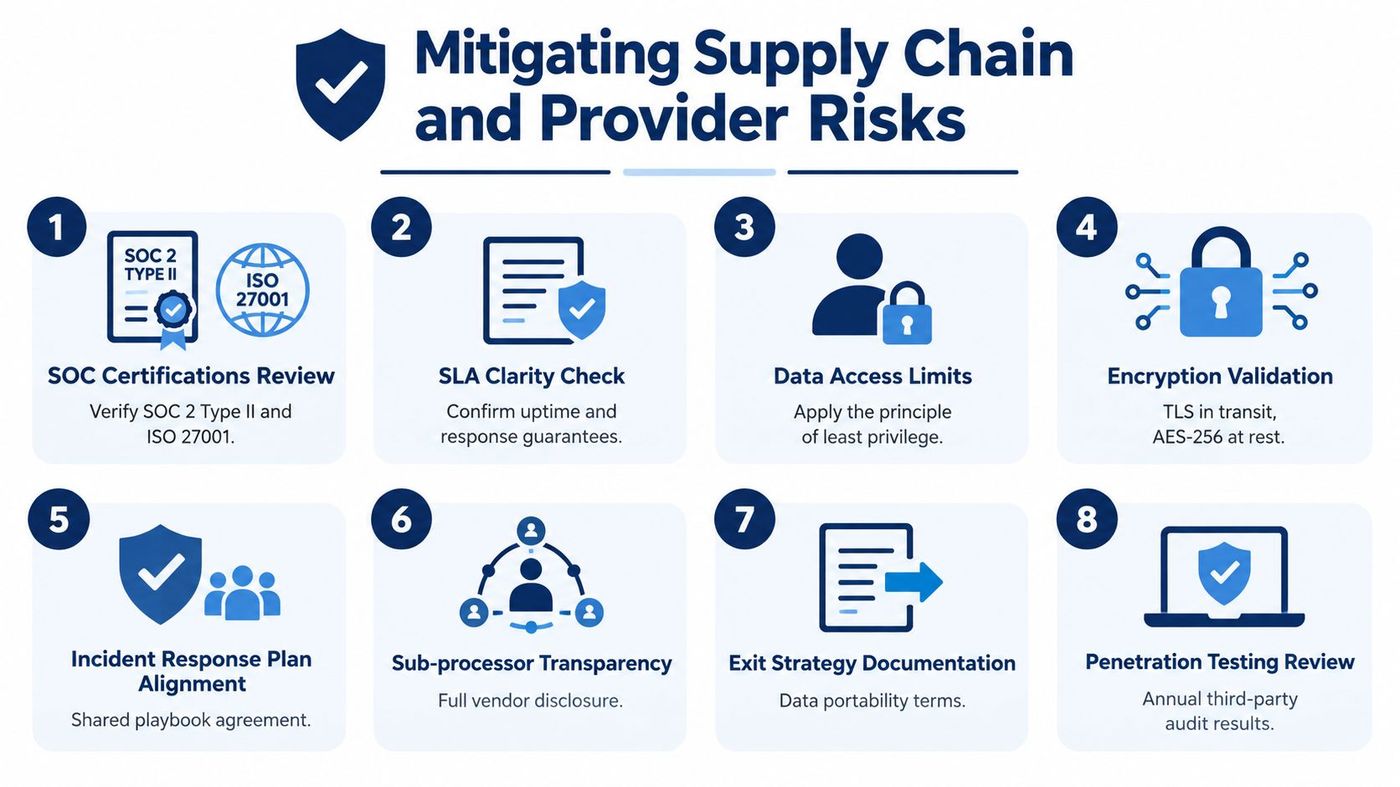
Outsourcing security doesn't eliminate risk. It changes the risk boundary. The Canadian Centre for Cyber Security warns that managed service providers are frequent targets because a compromise at the provider can affect many downstream clients. (National Cyber Threat Assessment)
That warning should make executives more selective, not more resistant to managed services. A provider with broad administrative access can either strengthen your security posture or create a concentrated point of failure. You need evidence that it has designed its own environment to limit that blast radius.
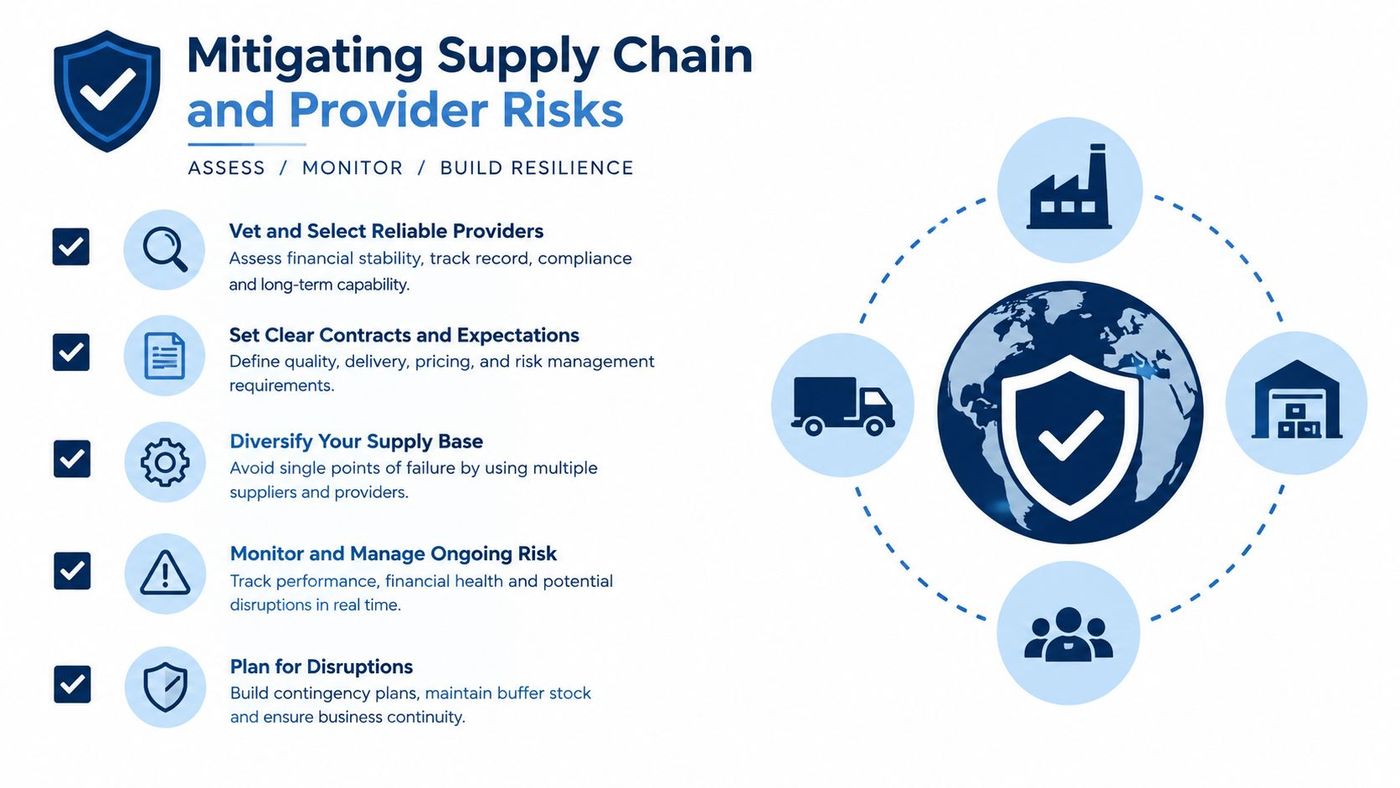
Ask the MSSP to explain its administration model in operational detail.
The provider should answer these questions with policy, contract language, and evidence rather than reassurance. The Canadian guidance specifically highlights segmented administration, strong logging, multifactor authentication, and tightly controlled privileged access as safeguards against cascading risk.
Your vendor governance shouldn't end at onboarding. Include the provider in your third-party risk management process, assign an internal owner, review service reports, and revisit access when your systems or business model changes.
The best arrangement creates mutual visibility. Your provider understands your critical processes and escalation contacts. Your leadership understands the provider's limits, service levels, access paths, and responsibilities during a crisis.
A successful MSSP transition starts with facts, not a product demonstration. Before selecting a provider, create a reliable inventory of users, endpoints, servers, cloud services, network devices, business applications, data repositories, backup systems, and third parties. Include systems that aren't formally managed. Forgotten assets often create the largest uncertainty.
The Canadian Centre for Cyber Security recommends that SMBs take stock of assets, prioritize risks as high, medium, or low, set target dates, identify resources, and review safeguards regularly. Use that approach to create an onboarding backlog rather than trying to solve everything at once. (Get Cyber Safe guide for SMBs)
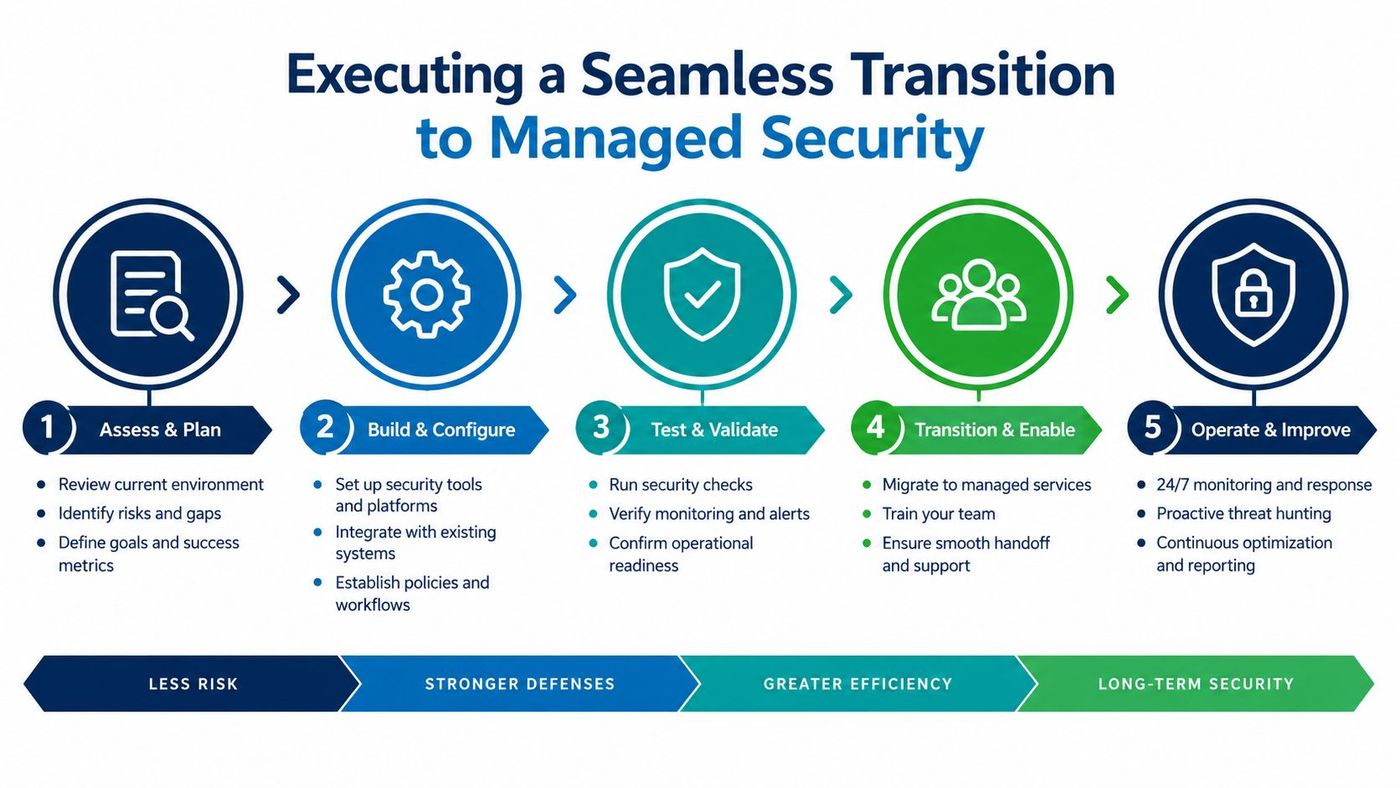
The transition should be staged so daily operations aren't disrupted. Keep internal IT involved, document every access path, and make the handoff collaborative. CloudOrbis Inc. provides managed IT support, managed detection and response, endpoint protection, vulnerability assessments, backup and disaster recovery, compliance support, and strategic IT consulting for Canadian small and mid-sized businesses.
If your organization can't sustain continuous monitoring and incident response with its current team, CloudOrbis Inc. can assess your environment, prioritize the gaps, and build a managed security operating model around your business. Contact CloudOrbis to discuss a practical transition that strengthens detection, response, compliance readiness, and recovery without disrupting daily work.
Book a 30-minute call with a senior engineer. No sales script, just straight answers about your environment.


