Vulnerability Assessment Methodology for SMBs
Learn a practical vulnerability assessment methodology for SMBs covering scoping, scanning, scoring, remediation, and reporting tailored to Canadian businesses.

Learn a practical vulnerability assessment methodology for SMBs covering scoping, scanning, scoring, remediation, and reporting tailored to Canadian businesses.
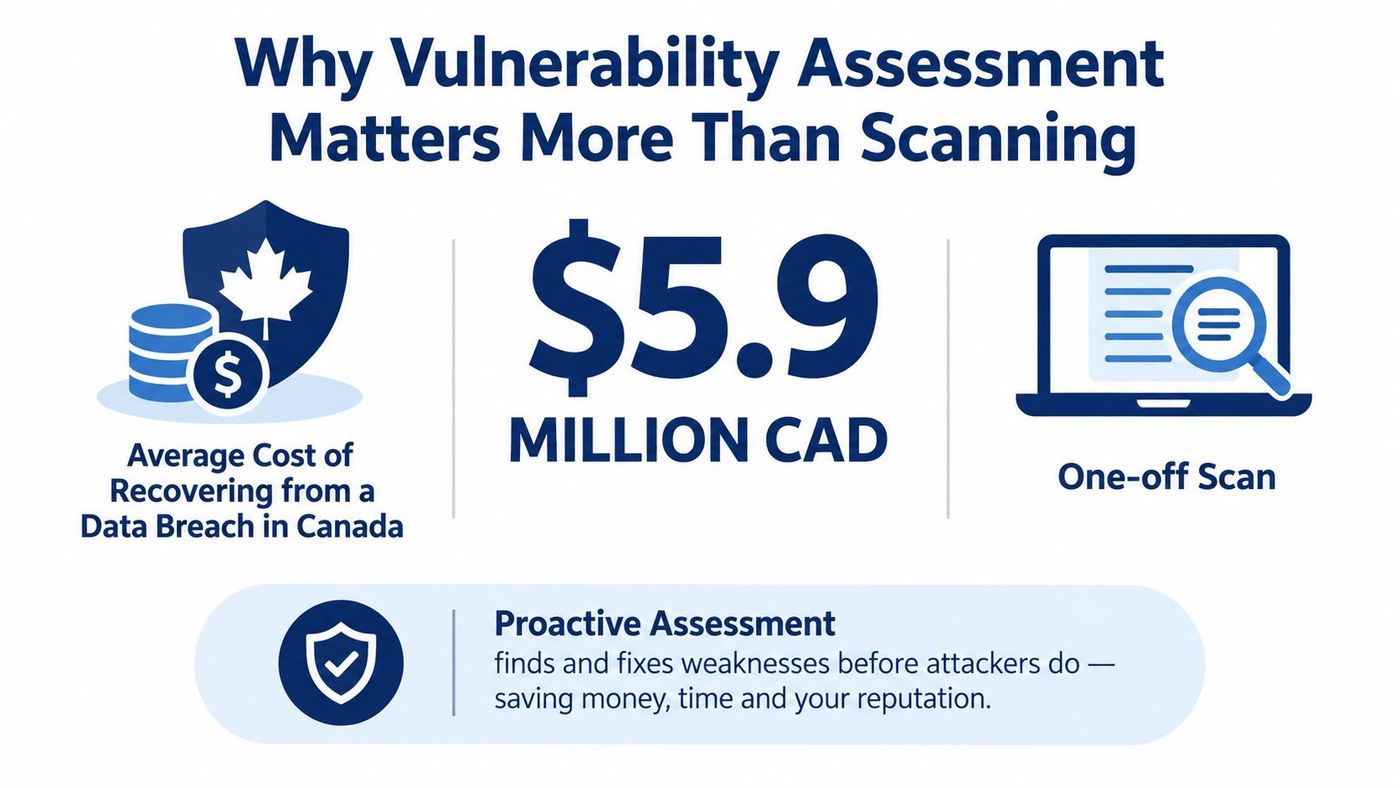
Canadian businesses spent approximately $1.2 billion recovering from cybersecurity incidents in 2023, double the roughly $600 million reported in 2021, even though the proportion affected fell to 16% from 18% over the same period (Statistics Canada). That reversal matters. Fewer incidents don't automatically mean lower business risk when individual events cost more to contain and recover from.
A vulnerability assessment methodology gives leaders a way to act on that reality. It connects asset discovery, technical evidence, business impact, remediation decisions, and verification in a repeatable lifecycle. A scanner is one input. It isn't the assessment.
For a Canadian healthcare clinic, manufacturer, legal practice, or finance company, the useful question isn't “How many vulnerabilities did the tool find?” It's “Which weaknesses threaten an important service, how credible is the exposure, who owns the fix, and how will we prove the risk was reduced?”
A scan produces findings. A defensible assessment produces risk decisions that people can act on.
The difference appears when a tool labels several issues “high.” An internet-facing identity weakness may require immediate attention because it could expose access to cloud services. A higher-scoring issue on a segmented internal host may warrant a different response if strong access controls and compensating measures reduce the practical path to exploitation. Applying the same deadline to both can divert limited technical capacity from the greater business risk.
The Government of Canada vulnerability-management guidance describes vulnerability risk assessment as the cornerstone of vulnerability management and recommends examining distinguishable risk factors before setting remediation priorities. That principle gives each audience usable evidence. Executives see operational exposure, service owners receive defined work, auditors can trace decisions, and insurers can assess whether exceptions are controlled.
A mature process should answer five practical questions:
Scanning remains necessary, but it serves these decisions rather than replacing them. CloudOrbis' overview of vulnerability scanning provides useful background, while a scan alone cannot establish business priority or prove that a compensating control works.
A vulnerability assessment methodology is the documented system an organisation uses to plan, perform, interpret, treat, and verify findings. It sets the assessment boundary, evidence requirements, responsibilities, scoring approach, response expectations, exception process, and reporting format. A scan is one event. The methodology governs the decisions before and after it.
Canadian guidance treats this work as a lifecycle covering governance, asset inventory, identification, risk assessment, treatment, metrics, and compliance (Canadian Centre for Cyber Security risk assessment guidance). Define those elements before choosing a scanner. Otherwise, the tool's default scope and severity labels can become the organisation's security policy.

A finding needs different treatment depending on who must act on it:
Asset criticality should shape every conclusion. A moderate technical weakness on a public-facing identity service may deserve faster treatment than a higher-scored issue on an isolated test host. Compensating controls, regulated information, recovery requirements, and supplier dependencies also belong in the decision record.
The boundary matters because a methodology does not promise to detect everything. It records what was assessed, how it was assessed, which evidence supports each conclusion, and what remains outside the evidence base. CloudOrbis' comparison of vulnerability management and vulnerability assessment distinguishes the assessment activity from the broader ongoing management programme.
A useful scope connects security testing to a business decision. Baseline reviews, pre-audit work, post-incident investigations, and acquisition due diligence each call for different evidence. Define the purpose first, then identify the systems and decisions the assessment must support.
Build the boundary from how the organization operates. Include on-premises infrastructure, cloud platforms, identity providers, remote access, third-party connections, applications, and operational systems. A healthcare clinic may need patient-management systems, Microsoft 365 identities, medical-device networks, backups, and remote clinics. For a legal practice, email, document management, file shares, remote access, and supplier portals may carry the greatest business impact. A manufacturer must decide whether production systems, building management, industrial controllers, and engineering workstations can be tested safely or need a separate controlled workstream.
Write the scope so another assessor could interpret it without a meeting. Record:
Keep the first engagement achievable. A smaller boundary with clear ownership produces more useful risk decisions than a broad scan no team can act on. An effective asset inventory management process helps keep scope aligned as systems change, while a signed scope and rules of engagement establish accountability.
For regulated organizations, document data sensitivity, recovery requirements, compensating controls, and supplier dependencies alongside the technical boundary. Those details determine whether an excluded or fragile system requires alternative evidence, additional approval, or a separate assessment path.
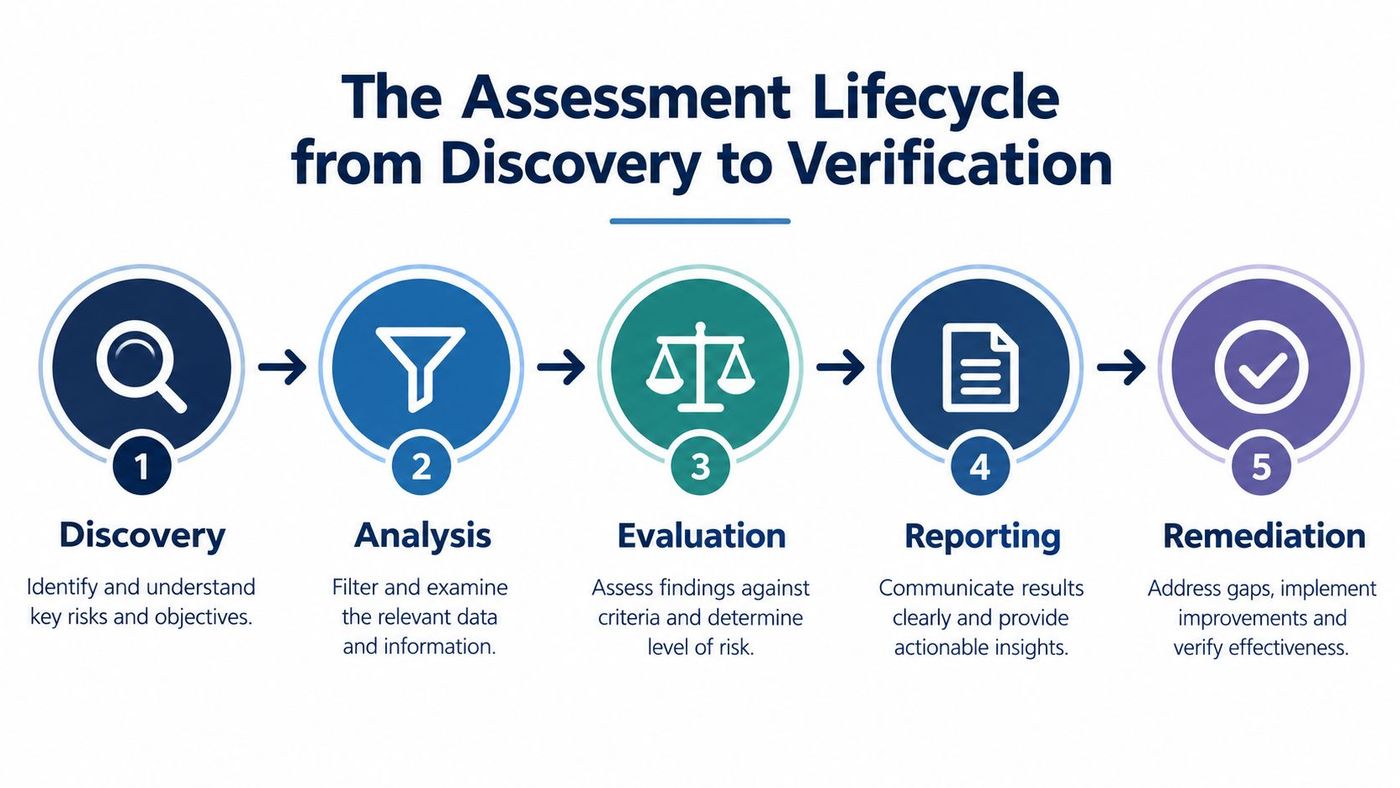
The lifecycle works when every phase has a clear output and an accountable owner. Skipping validation or verification is how teams create a large ticket queue without reducing meaningful exposure.
Discovery establishes what exists and how it connects. Use inventory records, network and host data, cloud consoles, endpoint agents, application registers, attack-surface monitoring, vendor information, and incident-response findings. The output should be an updated asset and dependency view, not just a scanner export.
Analysts examine potential findings, confirm affected versions and exposure paths, remove false positives, and assess exploitability. They then combine technical evidence with asset criticality, information sensitivity, operational impact, and available controls. The result is a ranked, documented risk register.
Treatment assigns a patch, configuration change, upgrade, compensating control, isolation measure, or formally accepted exception. Verification confirms that the corrective action worked, the exposure changed as expected, and the residual risk has an owner.
Repeatability matters as much as technical depth. The same scope, evidence standards, scoring logic, and closure criteria should support comparable assessments over time. A vulnerability management process can then show whether exposure is falling, exceptions are ageing, and important systems are receiving appropriate attention.
No detection method covers an entire environment. A risk-based assessment combines complementary evidence, then records what each technique could and could not observe. Canadian guidance supports using network and endpoint scanning alongside penetration testing, attack-surface monitoring, software-component analysis, vendor information, and threat intelligence.
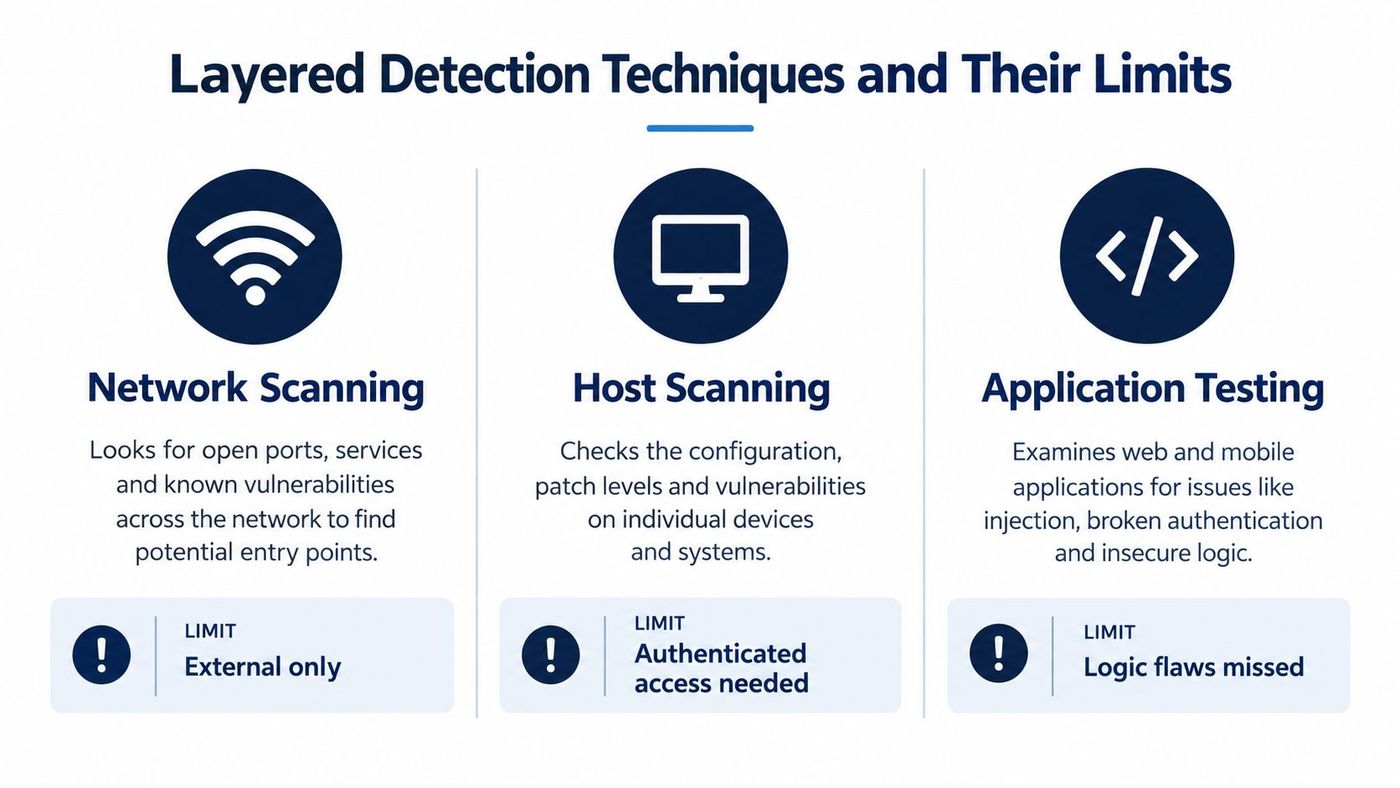
More scanning can create more findings without improving decisions. Layered evidence is useful only when analysts document coverage gaps, test safely around fragile clinical or industrial assets, and account for compensating controls. An intrusion detection system adds operational telemetry, but detection evidence and vulnerability evidence answer different questions. The former shows suspicious activity, while the latter identifies weaknesses that may permit it.
CVSS provides a useful technical severity estimate, but it does not determine business priority.
A flaw on an internet-facing identity service may deserve faster treatment than a higher-CVSS issue on a segmented internal host because exposure, reachability, and business dependency differ. A clinic protecting health information may assign greater urgency to an identity or backup weakness than a logistics company would assign to the same technical flaw. The Canadian Centre for Cyber Security recommends consistent CVE tracking and CVSS for initial severity, followed by adjustment for organisational context (Canadian Centre for Cyber Security risk assessment guidance).
The Government of Canada's standardised assessment tool uses a 50-point score. Risk-factor results are combined and mapped to a risk matrix that sets testing and correction time frames (Government of Canada vulnerability-management guidance). Smaller organisations do not need to reproduce every detail. They should retain the operating principle: score visible factors, record the reasoning, and link the result to a defined action.
| Factor | Why It Matters | Example Adjustment |
|---|---|---|
| Exposure | Internet accessibility and reachable attack paths affect practical likelihood. | Increase priority when a service is externally accessible. |
| Exploitability | Public exploit evidence or credible attack paths can shorten the response window. | Escalate when exploitation is active or readily reproducible. |
| Asset criticality | A weakness on a system supporting payroll, patient care, production, or dispatch can disrupt core operations. | Raise priority for business-critical services. |
| Data sensitivity | Personal, health, financial, privileged, and confidential information can increase impact. | Apply greater weight where sensitive information is exposed. |
| Compensating controls | Segmentation, monitoring, restrictive access, or virtual patching may reduce practical risk. | Reduce urgency only when the control is tested and documented. |
| Recovery complexity | Downtime, rollback difficulty, and specialist dependencies affect treatment decisions. | Escalate when recovery is slow or uncertain. |
Regulated organisations should preserve the basis for each adjustment, particularly where a control offsets a patch delay or where service disruption carries operational consequences. A defensible score makes uncertainty visible, allowing executives to accept, fund, or challenge the decision.
A scanner produces a hypothesis. An analyst determines whether the issue exists, creates meaningful risk, and requires action.
Start with the scanner's evidence. Confirm the asset, software version, configuration, exposure route, and detection signature. Reproduce material findings safely, preferably in a controlled environment that cannot interrupt production. Test whether a compensating control actually limits access or exploitation. Do not treat its presence as proof of protection.
Consider a TLS finding on a public application. The endpoint may appear exposed, while a reverse proxy terminates external connections and blocks direct access to the affected service. Validation should capture the proxy configuration, backend path, and control behaviour. A missing-patch alert may also identify a retired service that remains in inventory but no longer runs.
False-positive handling needs an audit trail, not a silent deletion. Preserve the reason for the decision, supporting evidence, analyst, date, affected asset, and approval authority. Record the control or configuration that supports the conclusion. If the service returns, the asset changes, or the architecture is redesigned, mark the finding for reassessment.
The Cyber Centre patching guidance calls for scanning when newly disclosed vulnerabilities may affect the environment, with scope and detection signatures updated for that trigger. This does not require uncontrolled testing whenever an advisory appears. It requires a prompt relevance check, safe validation, and a recorded explanation of why the organisation acted or did not act.
Treatment turns assessment findings into owned decisions. The recurring problem in Canadian environments is not always patch availability. It is deciding what to do when a fix could interrupt production, depends on a vendor, or conflicts with a regulated process.
Use three response tiers based on business risk, exposure, asset criticality, and available controls:
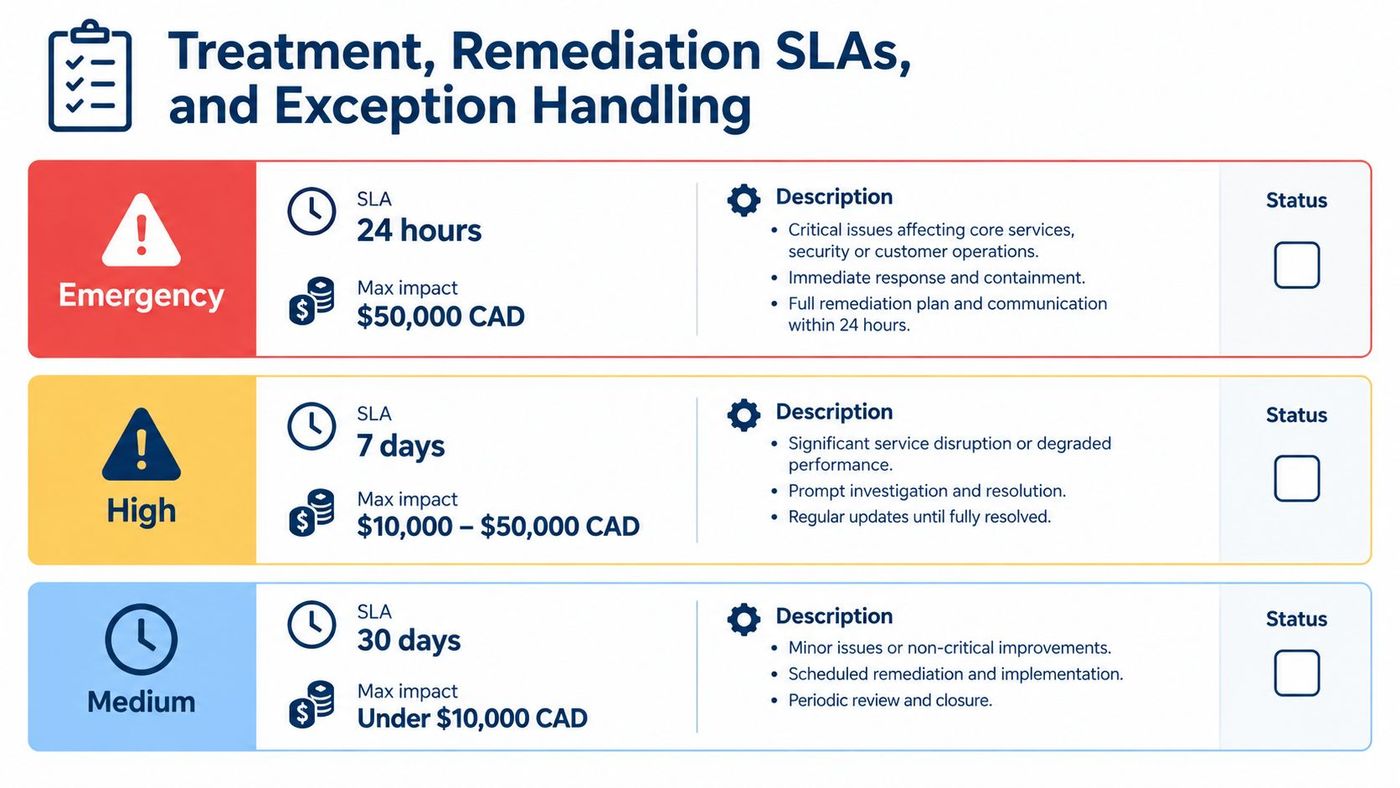
An exception is a governance mechanism, not a failure. A production device may need a vendor-approved maintenance window, tested rollback, segmentation, restricted administration, additional monitoring, or temporary isolation. Record the residual-risk owner, approval authority, review date, affected asset, and conditions that would end the exception.
Remediation records should connect the chosen action to the assessed risk. The Cyber Centre patching guidance supports timely corrective action, including patches and configuration changes. Ticket status alone does not close a finding. Closure requires evidence that the change was implemented and the vulnerability was retested. Where a delay is necessary, document why the exposure remains acceptable and which control limits it.
A defensible report lets another reviewer understand the finding without interviewing the analyst. Each material record should capture:
The executive summary should show scope, material business risks, overdue decisions, important exceptions, and trend direction. The technical register should preserve evidence and remediation detail. A treatment dashboard should show owners, due dates, status, ageing, verification, and residual risk.
Exceptions need plain language. State what remains exposed, why the organisation accepted it, which controls reduce the risk, and when the decision expires. Government guidance recommends transparent methods for combining risk factors and maintaining evidence of corrective action (Government of Canada vulnerability-management guidance).
Trend reporting should compare like with like. Record any change in scope, detection methods, or scoring rules so readers do not treat the results as directly comparable. Keep source evidence tied to each finding, rather than relying on dashboard status alone.
Compliance reviews rarely ask only whether a scanner ran. Auditors, insurers, and contractual reviewers expect evidence that the organisation understands its assets, evaluates exposure, assigns responsibility, tracks remediation, and approves exceptions deliberately.
For Canadian privacy obligations such as PIPEDA and Quebec's Law 25, retain asset and data context, access exposure, documented risk decisions, remediation records, and lessons from incidents. The Office of the Privacy Commissioner of Canada's PIPEDA guidance on safeguards reinforces the need to protect personal information according to the sensitivity and circumstances of the data. PCI DSS assessments benefit from a defined payment environment, recorded scan scope, treatment decisions, and verification evidence. Canadian health-data handlers with HIPAA-adjacent contractual or security expectations should preserve records covering patient-system scope, access controls, device dependencies, downtime risk, and corrective action.
Requirements vary by organisation, jurisdiction, contract, and service. One assessment report should not be presented as proof of every obligation. Build a reusable evidence set that supports multiple reviews while keeping the underlying facts consistent.
Maintain the scope statement, inventory review history, scan and test records, risk register, exception approvals, change tickets, retest evidence, and management reporting. Insurers may request recent vulnerability reports, remediation expectations, and proof that significant findings are tracked to closure.
A defensible methodology connects each finding to an owner, treatment decision, deadline, verification result, and residual-risk approver. Those records make vulnerability assessment an operating control rather than an annual document exercise. For regulated organisations, the same trail also shows how asset criticality, compensating controls, and service disruption risks shaped the final decision.
A medical device, manufacturing controller, building-management system, or transportation platform may react badly to techniques that are routine on workstations. Active probing, repeated authentication attempts, or an unexpected reboot can affect patient care, production, safety, or service continuity. The assessment method must therefore reflect both cyber risk and operational consequence.
Begin with passive discovery and architecture review. Compare switch, firewall, endpoint, vendor, and asset records to identify systems without aggressive probes. Examine configurations, firmware support, remote access, segmentation, administrative paths, backup arrangements, and known vendor advisories. The clinical, plant, facilities, or safety owner should approve active techniques before testing starts.
Testing conditions matter as much as tool selection. Confirm supported methods with the vendor, define a maintenance window, document rollback steps, and establish stop conditions that testers can apply immediately. Validate whether clinical or industrial assets are unnecessarily reachable from ordinary user networks, while avoiding changes that could interrupt service.
For systems that cannot be patched directly, treatment may include exposure reduction, segmentation, access restrictions, compensating monitoring, or tested recovery. Record the rationale, accountable owner, review date, and remaining risk. A legacy manufacturing controller may be safer after isolation and restricted access than after an unplanned patch that stops the line. A clinic should not report “zero critical vulnerabilities” if fragile devices were excluded from testing. Honest reporting identifies the exclusion and the controls protecting it.
After any approved change, verify both outcomes: the security control works, and the device or service still performs its operational function. That evidence supports a risk-based decision without turning patient care or production into a test environment.
| Stage | Owner | Input | Output | Acceptance Criteria |
|---|---|---|---|---|
| Discovery | Security and asset owners | Inventory, architecture, incident evidence | Scope and asset map | Important assets and exclusions are documented |
| Validation | Security analysts and service owners | Scanner and test findings | Confirmed findings | False positives are evidenced and material issues reproduced safely |
| Analysis | Security, IT, business owners | Technical and business context | Ranked risk register | Priorities reflect exposure, impact, exploitability, and controls |
| Treatment | Service owners and leadership | Approved findings | Remediation or exception records | Owners, due dates, controls, and approvals are present |
| Verification | Security and change owners | Change evidence | Retest and residual-risk record | Fixes are confirmed and remaining risk is accepted or escalated |
Use this maturity check:
For the next quarter, focus on an accurate inventory, a context-aware priority model, and verified remediation for the most exposed business-critical services. Those moves usually produce better decisions than increasing scan volume alone.
CloudOrbis Inc. can help Canadian SMBs review assets, run vulnerability assessments, validate findings, prioritise risk, track remediation, and produce executive-ready evidence. Visit CloudOrbis Inc. to discuss a methodology suited to your environment, sector, and operational constraints.
Book a 30-minute call with a senior engineer. No sales script, just straight answers about your environment.


